
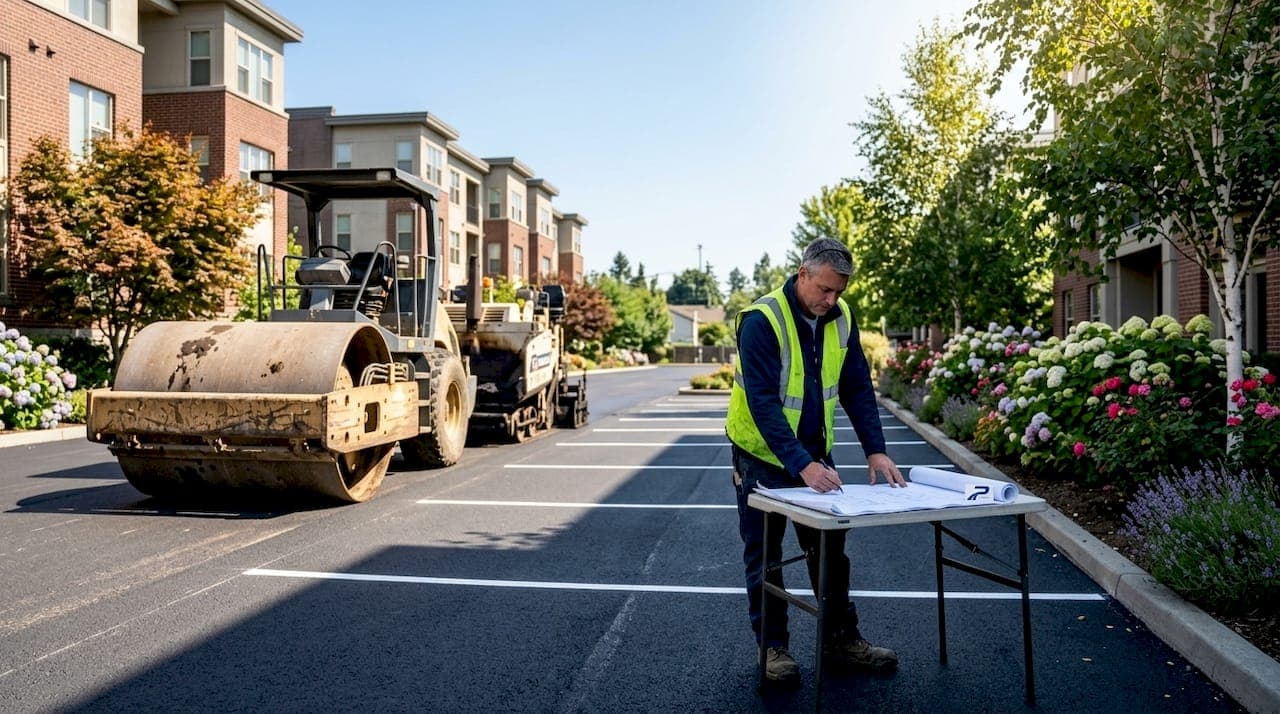
Rental property pavement upgrades are surface improvements, including resurfacing, overlays, crack repair, and restriping, that directly increase a property's curb appeal, tenant satisfaction, and long-term asset value. Landlords who treat pavement as infrastructure rather than cosmetic detail consistently outperform those who defer maintenance until failure forces a full rebuild. The right upgrade sequence, paired with ADA compliance and smart tax classification, turns a driveway or parking lot into a measurable return on investment. This guide covers what you need to know to make those decisions confidently.
What technical standards should you expect from pavement upgrades?
Rental property pavement upgrades fail most often not because of bad asphalt, but because of what happens underneath it. Subgrade preparation is the foundation of every durable surface. Before any paving begins, contractors should verify subgrade bearing capacity using ASTM Proctor compaction tests, which confirm the soil can support the load without shifting or settling. Skipping this step is the single most common cause of premature cracking within the first two to three years of a new surface.
Granular base installation and testing must be explicitly written into your contract scope. Failure to confirm subgrade bearing capacity or granular base completion routinely causes premature cracking and warranty disputes between property owners and contractors. If your bid does not mention base compaction testing, ask for it in writing before signing anything.
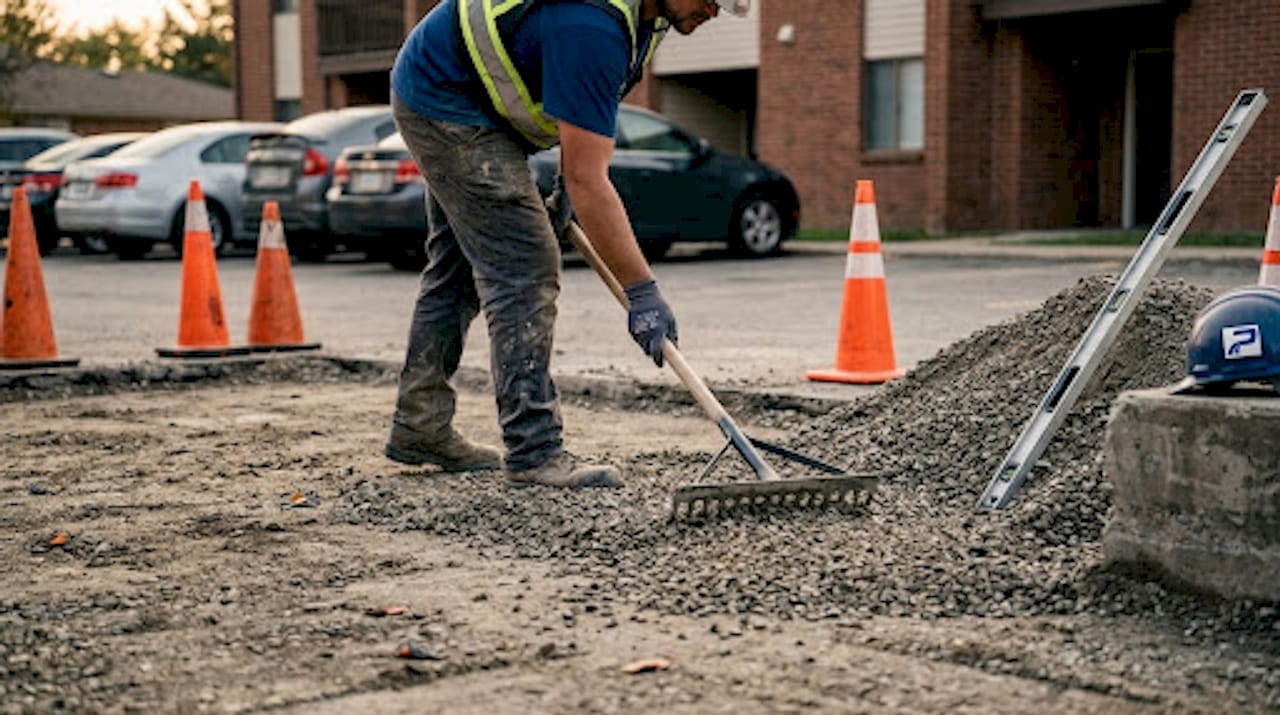
Drainage slope is equally non-negotiable. Minimum drainage slopes are 1.5% cross-slope for uncurbed parking areas and 1% for curbed lots draining to catch basins. These numbers are not suggestions. Ponding water accelerates oxidation, softens the base, and cuts pavement life by years. Drainage design is often a more critical factor in pavement longevity than asphalt thickness or surface treatment.
For overlay work, thickness specifications follow mechanistic-empirical design protocols, not guesswork. Minimum HMA overlay thicknesses are 3.5 inches over existing asphalt and 4.5 inches over existing concrete. These figures carry design tolerances of plus or minus 1 to 1.5 inches, meaning your contractor should be able to show you the structural analysis behind their recommendation. Common asphalt mix designs for rental property work include Superpave SP-12.5 for surface courses and SP-19 for base courses.
Here is a practical checklist for evaluating any contractor bid on pavement work:
- Confirm subgrade compaction testing is included and specify the ASTM standard.
- Require documentation of granular base thickness and material type.
- Verify drainage slopes are specified in the written scope, not assumed.
- Confirm asphalt mix design by name (SP-12.5, SP-19) and lift thickness in writing.
- Request post-installation density testing and proof rolling as quality assurance steps.
- Specify warranty terms and what voids them, particularly water infiltration from poor drainage.
Pro Tip: Ask every contractor for a written scope that includes compaction test results and drainage slope calculations. A contractor who cannot provide these documents is not equipped to guarantee their work.
How do ADA regulations affect rental property pavement upgrades?
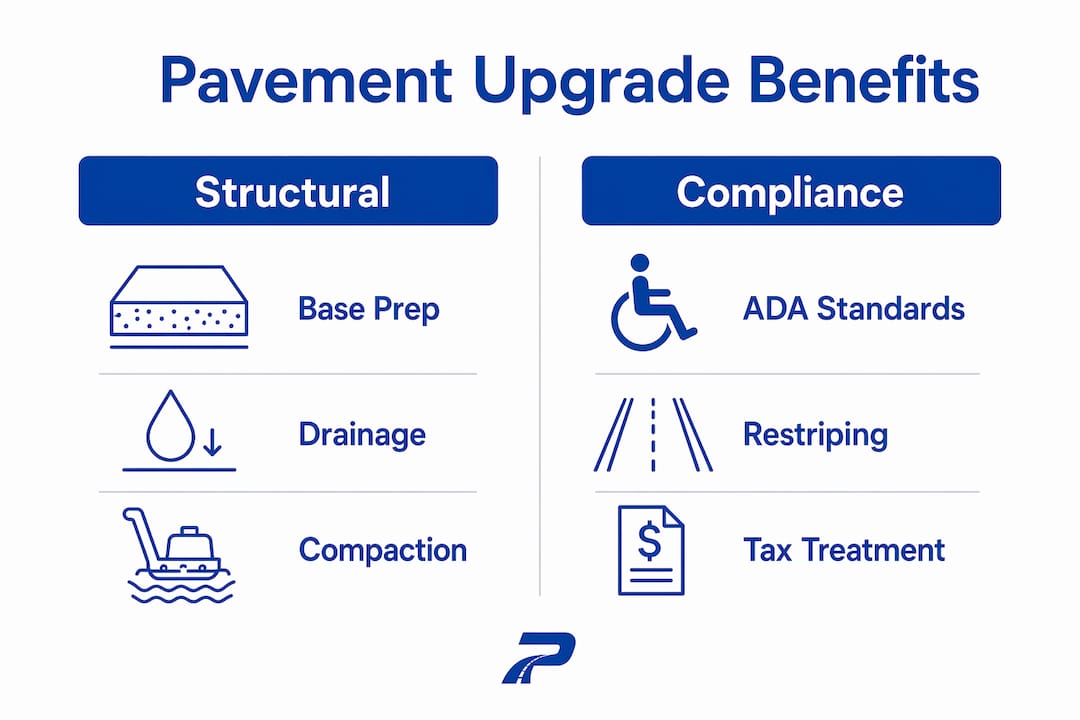
Any time you restripe a parking lot or add accessible spaces, ADA compliance obligations are triggered. This is not optional, and the penalties for non-compliance include costly retrofits, fines, and liability exposure. The 2010 ADA Standards for Accessible Design set the baseline every rental property owner must meet.
The core requirements for accessible routes and parking are:
- Accessible routes must be at least 3 feet wide with a firm, stable, slip-resistant surface.
- Route slopes cannot exceed 1:12 (approximately 8.3%) in the direction of travel.
- Accessible parking spaces must be located on the shortest accessible route to the building entrance, not clustered in a convenient corner of the lot.
- Van-accessible spaces require either a 60-inch or 96-inch wide access aisle, depending on configuration.
- Vertical clearance for van-accessible spaces must be at least 98 inches throughout the route.
- Every van-accessible space must include a "van accessible" sign mounted at the correct height.
The table below summarizes the key dimensional requirements for ADA-compliant parking:
| Requirement | Standard |
|---|---|
| Accessible route width | Minimum 3 feet |
| Maximum route slope | 1:12 (8.3%) |
| Van-accessible aisle width | 60 inches or 96 inches |
| Van-accessible vertical clearance | Minimum 98 inches |
| Space distribution | Near all accessible building entrances |
For Tennessee property owners, Pinnaclepave has published a detailed ADA compliance resource covering state-specific requirements that go beyond the federal baseline. Reviewing it before any restriping project can save you from expensive corrections after the fact.
Restriping or adding accessible spaces triggers full ADA compliance obligations for the entire parking facility, not just the spaces being modified. This is the detail most landlords miss. A partial restripe of one section can legally require you to bring the whole lot into compliance.
What are the tax implications of pavement repairs versus capital improvements?
The IRS distinguishes pavement work into two categories, and the difference determines whether you deduct the cost this year or depreciate it over decades. Getting this classification wrong is one of the most common and costly mistakes rental property owners make.
The IRS applies the BAR test, which stands for Betterment, Adaptation, and Restoration, to determine whether work qualifies as a capital improvement. Capital improvements extend property useful life or add value, while repairs simply restore the property to its prior condition. Residential rental property improvements depreciate over 27.5 years using the straight-line method with a mid-month convention.
| Work Type | Tax Treatment | Example |
|---|---|---|
| Repair | Deduct immediately | Filling potholes, crack sealing |
| Capital improvement | Depreciate over 27.5 years | Full resurfacing, new driveway installation |
| Restoration | Capitalize and depreciate | Rebuilding failed base and repaving |
The IRS uses the BAR test to classify work: Betterment adds value or corrects a defect, Adaptation changes the use of the property, and Restoration returns a deteriorated component to working condition. Sealcoating and crack filling typically qualify as repairs. A full overlay or new parking lot construction qualifies as a capital improvement.
Safe harbor rules under IRS regulations allow some smaller expenses to be deducted immediately even if they might otherwise qualify as improvements. The de minimis safe harbor applies to amounts up to $2,500 per invoice for taxpayers without an applicable financial statement. Documenting your project scope carefully, and separating repair work from improvement work in contractor invoices, gives you the flexibility to optimize deductions without triggering an audit.
Pro Tip: Ask your contractor to issue separate invoices for repair work (crack sealing, pothole patching) and improvement work (overlay, new surface installation). This single step gives your accountant the documentation needed to maximize your immediate deductions.
Differentiating repairs from capital improvements early in the project planning phase can optimize tax benefits and reduce audit risk. Make this conversation happen before the contractor starts work, not after.
How do you choose and sequence upgrades to maximize ROI?
The biggest mistake landlords make when improving rental property driveways and parking areas is treating pavement as a cosmetic problem. A fresh sealcoat over a failing base is money wasted. Sealcoating and patching are effective early lifecycle interventions only after base and subgrade deficiencies have been addressed. Skipping structural fixes to save money upfront guarantees a full reconstruction bill within five years.
The correct sequence for cost-effective pavement upgrades follows a lifecycle approach:
- Drainage correction first. Fix any grading or slope issues before spending a dollar on surface work. Water is the primary cause of pavement failure, and no surface treatment survives a drainage problem.
- Crack sealing second. Address surface cracks before they allow water infiltration into the base. This is the highest-return maintenance activity available to rental property owners.
- Sealcoating third. Apply sealcoat to oxidized but structurally sound surfaces to restore flexibility and UV protection. Fixing surface appearance alone without addressing base or drainage issues risks early failure.
- Overlay or resurfacing fourth. When surface distress is widespread but the base remains sound, a properly specified overlay extends pavement life by 10 to 15 years.
- Full reconstruction last. Reserve this for pavements with base failure or subgrade problems that surface treatments cannot fix.
For rental property owners managing multiple units, Pinnaclepave's guide on parking lot maintenance outlines how to assess pavement condition and prioritize spending across a portfolio.
When vetting contractor bids, require a written scope that specifies every step from subgrade prep through final surface treatment. Vague bids that describe work in general terms without material specifications or compaction standards are a warning sign. The Tennessee pavement standards compliance guide from Pinnaclepave provides a useful benchmark for what a complete scope should include.
Pro Tip: Get at least three bids and compare them line by line against a standard scope of work. The lowest bid is almost never the best value when it omits subgrade testing, drainage correction, or material specifications.
Key takeaways
Rental property pavement upgrades deliver the strongest returns when structural integrity, ADA compliance, and correct tax classification are addressed together from the start of project planning.
| Point | Details |
|---|---|
| Structural prep comes first | Subgrade compaction and drainage correction must precede any surface treatment. |
| ADA triggers are automatic | Restriping any portion of a lot activates full ADA compliance obligations for the facility. |
| Tax classification matters | Separate repair and improvement invoices to maximize immediate deductions under IRS safe harbor rules. |
| Sequence drives ROI | Drainage, crack sealing, sealcoating, overlay, and reconstruction must follow lifecycle order. |
| Contractor scope is everything | Written specs for mix design, lift thickness, and compaction testing protect you from warranty disputes. |
Why most landlords get pavement upgrades backwards
After working alongside property owners on pavement projects across Tennessee, the pattern I see most often is this: a landlord notices the lot looks rough, calls for a sealcoat, and considers the problem solved. Two years later, the cracks are back and wider. The base was never addressed. The drainage was never corrected. The sealcoat was applied to a surface that was already failing structurally.
The landlords who get the best results treat pavement the way a good investor treats any capital asset. They assess the condition systematically, address root causes before cosmetic fixes, and build contractor relationships with people who can show their work through compaction test results and documented drainage calculations. They also plan the tax treatment before the project starts, not after the invoice arrives.
The ADA piece surprises more owners than any other. A simple restripe to freshen up faded lines can legally obligate you to retrofit the entire facility. Knowing this before you call a striping contractor changes the conversation entirely. It also creates an opportunity: a properly planned restripe that brings the lot into full ADA compliance is a genuine value-add for tenants and a liability reduction for you.
The upgrades that deliver the strongest investment returns are not always the most visible ones. Drainage correction, base repair, and proper overlay thickness rarely show up in a before-and-after photo, but they are the difference between a surface that lasts 15 years and one that fails in five.
— Dillan
Ready to upgrade your rental property pavement?
Pinnaclepave handles every phase of rental property pavement work, from initial condition assessments and drainage analysis to full-depth asphalt paving, professional sealcoating, and ADA-compliant striping. The team brings professional-grade equipment, honest pricing, and drone-documented results to every job across Tennessee and the Southeast.
Whether you need a single pothole repaired or a complete parking lot rebuilt to current ADA and drainage standards, Pinnaclepave delivers a written scope, material specifications, and quality assurance documentation on every project. Contact Pinnaclepave for a site assessment and personalized quote that covers both your immediate needs and your long-term pavement plan.
FAQ
What counts as a pavement upgrade for a rental property?
Rental property pavement upgrades include resurfacing, asphalt overlays, crack sealing, sealcoating, drainage correction, and parking lot restriping. Any work that improves surface condition, extends pavement life, or adds accessible features qualifies.
Does restriping a parking lot trigger ADA compliance?
Yes. Restriping any portion of a parking lot triggers ADA compliance obligations for the entire facility under the 2010 ADA Standards, including accessible space dimensions, signage, and route requirements.
How is pavement repair taxed differently from a capital improvement?
Repairs that restore pavement to its original condition are deducted immediately. Capital improvements that add value or extend useful life are depreciated over 27.5 years for residential rental properties under IRS rules.
What is the minimum overlay thickness for asphalt resurfacing?
The minimum HMA overlay thickness is 3.5 inches over existing asphalt and 4.5 inches over existing concrete, based on mechanistic-empirical design protocols used by state DOTs.
How often should rental property pavement be sealcoated?
Sealcoating is most effective every three to five years on structurally sound pavement. Applying it to surfaces with base or drainage problems wastes the investment and delays necessary structural repairs.