
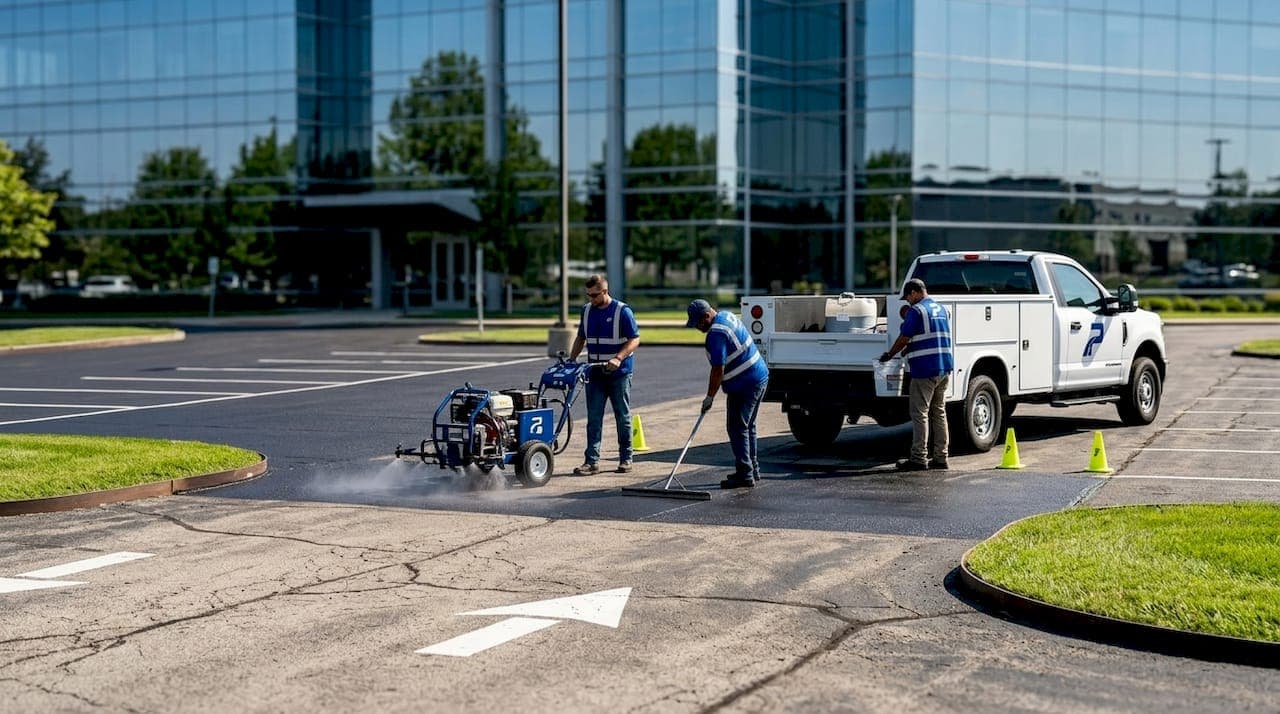
Walk any commercial strip in Tennessee and you'll spot the difference almost instantly — some parking lots look sharp and hold up year after year, while others are cracked, faded, and crumbling after just a few seasons. The gap usually isn't luck or budget. It's the coating choice. Most property owners treat pavement coating as a single product decision, but it's actually a category with dozens of distinct materials, each built for specific surfaces, traffic loads, and climate conditions. Get it right and your pavement can last significantly longer. Get it wrong and you'll be calling for repairs far sooner than you should.
Table of Contents
- Understanding pavement coating basics: What property owners need to know
- Asphalt-based coatings: Prime, tack, and surface treatments for Tennessee properties
- Concrete pavement coatings: Penetrating and film-forming solutions
- Eco-safe and high-performance coatings: Navigating TN regulations and environmental concerns
- Choosing the right coating: Factors for Tennessee commercial properties
- Real-world lessons: What most property managers get wrong about pavement coatings
- Next steps: Expert solutions for Tennessee pavement coatings
- Frequently asked questions
Key Takeaways
| Point | Details |
|---|---|
| Coating selection matters | Choosing the correct pavement coating greatly extends lifespan and improves property curb appeal. |
| Tennessee regulations impact choices | Local laws often restrict materials like coal tar; eco-safe options are preferred and compliant. |
| Performance varies by coating type | Epoxy and polyaspartic coatings last up to 10 years indoors, while asphalt emulsions suit lower-impact areas but require more frequent application. |
| Hybrid applications can boost results | Combining squeegee and spray methods achieves better coverage and durability for commercial pavements. |
| Professional assessment is invaluable | Get expert advice before selecting or renewing pavement coatings to avoid common pitfalls and maximize value. |
Understanding pavement coating basics: What property owners need to know
Pavement coating is any protective layer applied to an asphalt or concrete surface to guard against water intrusion, UV degradation, oxidation, and surface wear. It's the difference between a surface that lasts 15 to 25 years and one that starts showing serious deterioration by year 7 or 8. For commercial properties in Tennessee, where summer heat regularly pushes pavement temperatures well above 130°F and freeze-thaw cycles can stress surfaces through the winter months, choosing the right coating isn't optional — it's core maintenance strategy.
The major categories break down along surface type and function:
- Bituminous (asphalt-based) coatings: These include prime coats, tack coats, slurry seals, micro-surfacing, and fog seals. All are formulated to work with asphalt surfaces and provide bonding, sealing, or surface restoration.
- Penetrating concrete sealers: Silane and siloxane-based products that absorb into the concrete matrix without forming a visible surface film. Excellent for moisture protection.
- Film-forming coatings: Epoxy, polyurethane, and polyaspartic systems that sit on top of the surface and create a hard, durable protective shell. Ideal for high-visibility and high-wear zones.
- Acrylic sealers: A middle-ground option with good UV resistance and aesthetic appeal, often used for decorative concrete and exterior surfaces.
According to UFGS pavement surface treatment standards, bituminous prime and tack coats serve a specific bonding function between pavement layers, while surface treatments like slurry seal and micro-surfacing are designed for low-speed commercial traffic areas. Understanding these distinctions before you select a product is what separates a smart capital investment from an expensive mistake. For more foundational context, the asphalt terminology explained guide breaks down the vocabulary every property manager should know.
Pro Tip: Before purchasing any coating, verify with your local jurisdiction whether coal tar-based products are restricted. Several municipalities are moving away from coal tar entirely due to environmental and health concerns, and using a prohibited product can create liability issues.
Asphalt-based coatings: Prime, tack, and surface treatments for Tennessee properties
For asphalt commercial pavements, the treatment landscape includes several distinct products, each serving a specific role in pavement preservation. Understanding the differences helps you avoid over-specifying or under-protecting your surface.
Prime coats are applied to a prepared aggregate base before the first layer of asphalt is laid. They penetrate the base and bind loose material, creating a stable foundation that helps the asphalt bond properly. Tack coats are sprayed between existing and new asphalt layers to ensure adhesion and prevent slippage. These are rarely visible to the end user but are critical to structural performance.
Surface treatments serve a different purpose. They're applied to existing, worn pavement to restore protection and extend service life:
- Slurry seal combines asphalt emulsion, aggregate, water, and additives into a slurry applied across the surface. It fills minor cracks and restores a uniform appearance.
- Micro-surfacing is a polymer-modified version of slurry seal, offering faster cure times and better performance under heavier traffic loads. It's well-suited for Tennessee commercial parking areas.
- Fog seal is a light application of diluted asphalt emulsion used to rejuvenate aging, oxidized pavement. It slows surface raveling but provides minimal structural benefit.
| Coating type | Durability | Best use case | Traffic suitability |
|---|---|---|---|
| Slurry seal | 3 to 5 years | Low-traffic lots, residential areas | Low to moderate |
| Micro-surfacing | 5 to 7 years | Commercial parking, access roads | Moderate to heavy |
| Fog seal | 1 to 3 years | Surface rejuvenation, oxidation control | Low only |
| Polymer-modified seal | 4 to 7 years | Heavy TN commercial traffic zones | Heavy |
Expert insight: Surface treatment standards confirm that micro-surfacing is the preferred option for low-speed commercial areas due to its rapid return to service. For Tennessee properties with active drive-thru lanes or busy retail parking, downtime matters as much as durability.
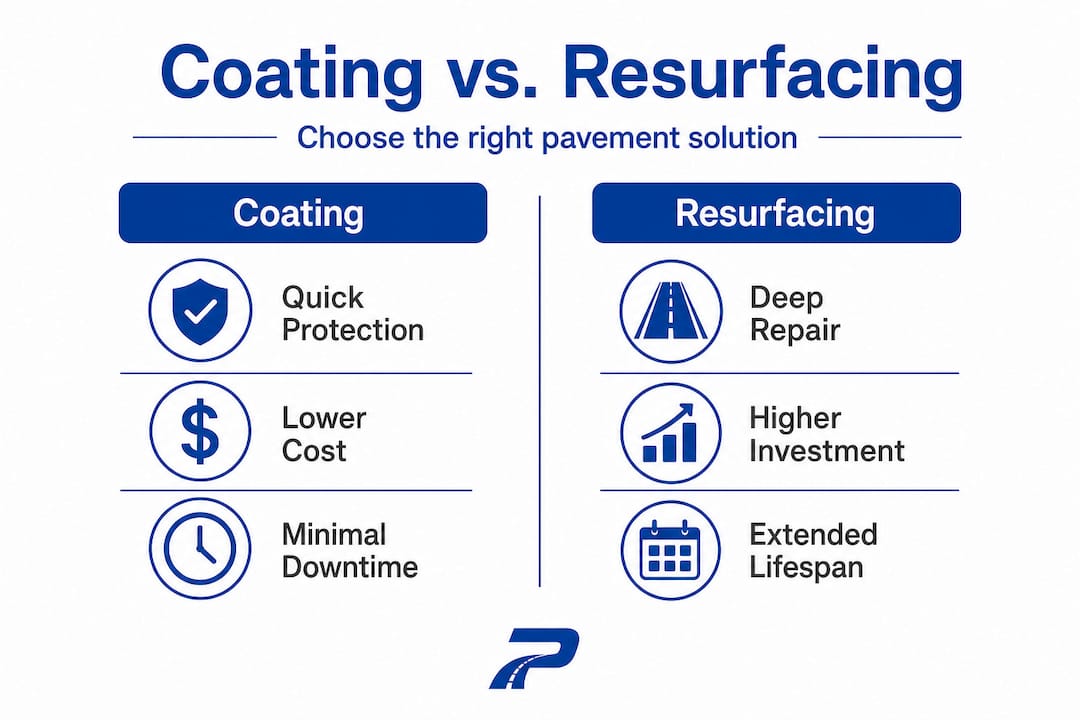
For a deeper comparison of when coating makes sense versus full resurfacing, the sealcoat vs. resurfacing guide is a strong reference point. If your surface has structural damage rather than surface wear, no coating product will solve the underlying problem. Pinnacle's Tennessee asphalt services cover both scenarios with professional assessment before work begins.
Pro Tip: Polymer-modified sealers outperform standard asphalt emulsion in high-traffic Tennessee settings. The polymer additives improve flexibility, adhesion, and resistance to fuel and oil spills — common in commercial lots.
Concrete pavement coatings: Penetrating and film-forming solutions
Concrete surfaces present a completely different set of challenges. Unlike asphalt, concrete is rigid and highly porous, making it vulnerable to chloride intrusion, freeze-thaw damage, and surface scaling. The right coating strategy depends on whether you need moisture protection, chemical resistance, or surface aesthetics — and often all three.
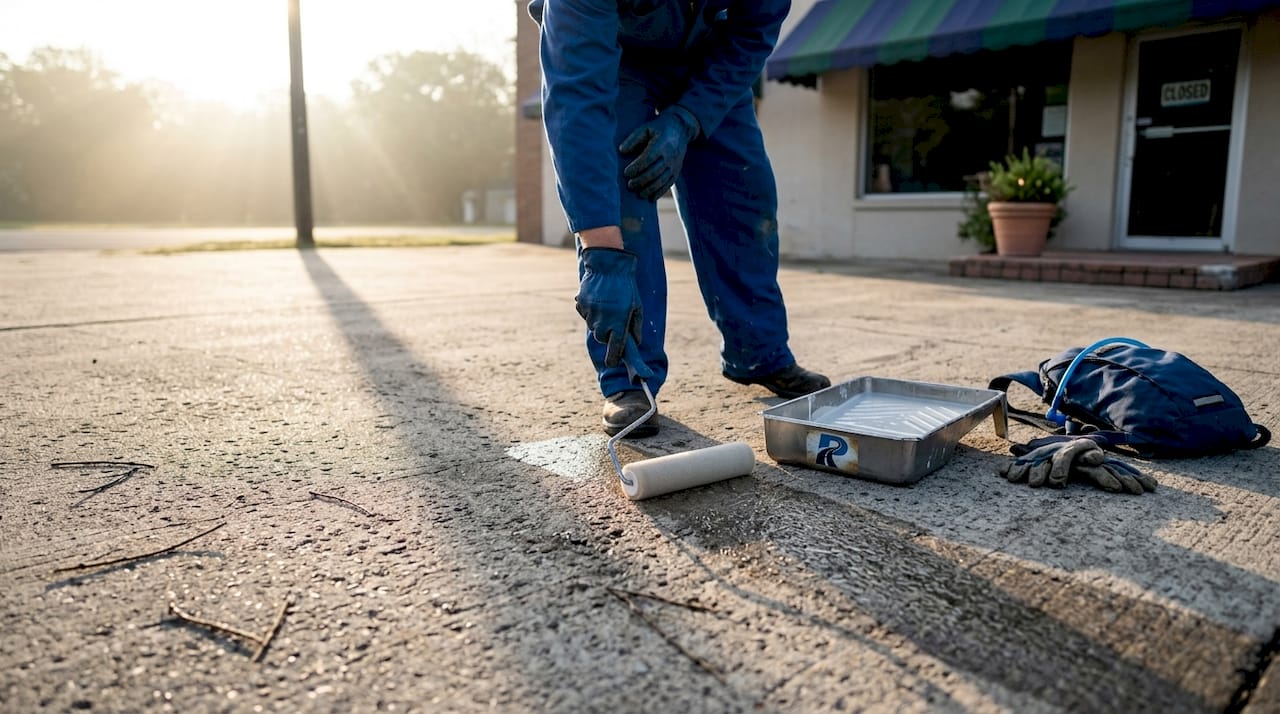
Penetrating sealers like silane and siloxane work by absorbing into the concrete matrix and lining the pores without forming a surface film. This makes them nearly invisible but highly effective at reducing water absorption, which is the primary driver of concrete deterioration. They work particularly well on exterior concrete subject to rain and freeze-thaw cycling.
Film-forming coatings take a different approach. They create a hard layer on top of the concrete surface, offering protection and improving appearance:
- Epoxy coatings bond chemically to concrete and create a dense, hard surface with outstanding chemical resistance. They're ideal for warehouse floors, parking garages, and service bays. Lifespan indoors runs 5 to 10 years.
- Polyurethane coatings are more flexible than epoxy and handle UV exposure better, making them suitable for exterior applications. Expect 3 to 8 years of service life.
- Polyaspartic coatings are the newest generation of film-forming systems, offering fast cure times (sometimes under an hour) and a lifespan comparable to epoxy at 5 to 10 years. They're becoming the premium choice for commercial facilities that can't afford extended downtime.
| Coating type | Lifespan | Cure time | Best application |
|---|---|---|---|
| Silane/siloxane penetrating sealer | 5 to 10 years | 24 to 48 hours | Exterior concrete, driveways |
| Epoxy | 5 to 10 years (interior) | 24 to 72 hours | Warehouse floors, garages |
| Polyurethane | 3 to 8 years | 8 to 24 hours | Exterior and UV-exposed zones |
| Polyaspartic | 5 to 10 years | 1 to 4 hours | High-traffic commercial interiors |
Performance note: Epoxy and polyaspartic systems are engineered for environments where surface integrity directly affects operations. A distribution center or multi-story parking garage simply can't afford a coating that requires reapplication every two years.
For commercial Tennessee properties with concrete floors or structures, epoxy floor coatings represent one of the highest-value protective investments available. And if you want to understand the broader value of surface protection, the benefits of sealcoating outline applies across both asphalt and concrete contexts. For a broader surface comparison, interlocking vs concrete provides additional perspective on material selection.
Eco-safe and high-performance coatings: Navigating TN regulations and environmental concerns
The shift away from coal tar sealers is one of the most significant changes in commercial pavement maintenance over the last decade. Coal tar is exceptionally durable, but it contains polycyclic aromatic hydrocarbons (PAHs), which are recognized as toxic to aquatic life and potentially harmful to human health. Several states and municipalities have banned or restricted its use outright.
In Tennessee, it pays to stay ahead of regulatory trends rather than scramble to comply after the fact. Coal tar has been phased out in many markets in favor of asphalt emulsion and polymer-modified alternatives, which offer lower environmental impact. Asphalt emulsion sealers have a shorter service life than coal tar, typically in the 2 to 4 year range, but they're compliant, widely available, and perform well when properly applied.
For premium durability with a cleaner environmental profile, polymer-modified sealers and acrylic coatings are the strongest options. Acrylic sealers in particular offer excellent UV resistance and color retention, making them a smart choice for properties where curb appeal drives business value.
Key considerations for eco-safe coating selection:
- Verify local restrictions before specifying any coal tar product, even if available through a supplier
- Choose polymer-modified asphalt emulsion for high-traffic Tennessee commercial zones requiring regulatory compliance
- Consider acrylic sealers for exterior concrete and decorative surfaces that need UV stability over multiple seasons
- Use hybrid application methods that combine squeegee and spray techniques, which improve penetration and uniformity beyond what either method achieves alone
- Plan for more frequent maintenance with asphalt emulsion products compared to polymer-modified alternatives
For a full breakdown of compliant options relevant to Tennessee commercial operators, the eco-safe pavement alternatives guide is worth reviewing. The sealcoating benefits page also addresses how proper coating selection contributes to long-term cost control. For additional perspective on sustainable paving choices, this overview of eco-friendly paving advantages covers the broader environmental conversation.
Choosing the right coating: Factors for Tennessee commercial properties
With a clear picture of what's available, the next challenge is matching the right product to your specific property. There's no single best coating — the right answer depends on a combination of variables that are unique to your site.
Key decision factors:
- Surface type: Asphalt and concrete require entirely different product chemistries. Never apply an asphalt-formulated sealer to concrete.
- Traffic volume and type: Heavy trucks and frequent vehicle turnover accelerate surface wear. High-traffic zones need polymer-modified or polyaspartic systems.
- Climate exposure: Tennessee properties face both intense summer heat and periodic winter freeze-thaw cycles. Flexibility and UV stability matter.
- Budget and maintenance schedule: Longer-lasting coatings cost more upfront but reduce the frequency of reapplication. Factor in total lifecycle cost, not just material price.
- Local regulatory requirements: Confirm restrictions on coal tar and any stormwater compliance requirements before specifying products.
Step-by-step selection framework:
- Evaluate the surface condition. Cracks, structural damage, and surface delamination need repair before any coating is applied. Coating over a compromised surface accelerates failure.
- Identify the surface material. Asphalt, concrete, or a mix? Each opens a specific product category.
- Assess traffic patterns. Light pedestrian and passenger vehicle traffic has very different requirements than a distribution facility entrance with heavy truck traffic.
- Check local codes and restrictions. Contact your municipality or review Tennessee pavement standards before finalizing product selection.
- Select the coating. Match product to surface type, traffic load, and regulatory environment.
- Plan your maintenance cycle. Based on coating lifespan data — epoxy at 5 to 10 years, polyurethane at 3 to 8 years, polyaspartic at 5 to 10 years — build reapplication into your property maintenance calendar.
Real-world lessons: What most property managers get wrong about pavement coatings
After working on commercial pavements across Tennessee, one pattern shows up repeatedly: property managers focus almost entirely on product selection and almost not at all on preparation and application technique. They'll spend time comparing sealers online, get three quotes, and choose the cheapest option — then wonder why the coating is peeling within 18 months.
Here's the uncomfortable truth. A mid-grade polymer-modified sealer applied correctly with proper surface prep will outperform a premium product rushed onto a dirty, unrepaired surface. Every time. The product is only as good as the surface it bonds to and the method used to apply it.
The other mistake we see constantly is treating pavement coating as a cosmetic service rather than a maintenance investment. When sealcoating benefits are measured over a 10 to 15 year period, the ROI is clear. Properties that follow a consistent coating and maintenance schedule spend significantly less on structural repair than those that skip maintenance and eventually face full replacement.
Hybrid squeegee-spray application is rarely discussed in generic contractor conversations, but it's one of the most effective techniques available. The squeegee works the material into the surface texture while the spray delivers uniform coverage across open areas. The combination produces better adhesion and a more consistent finished appearance than either method alone. It's the kind of operational detail that separates contractors who know their craft from those who just own equipment.
Our honest advice: invest in a professional surface assessment before any coating project. What looks like a sealer job from the parking lot might actually be a patching and resurfacing job in disguise. Applying coating over underlying structural problems doesn't extend pavement life. It temporarily masks the problem while it gets worse underneath.
Next steps: Expert solutions for Tennessee pavement coatings
Choosing the right pavement coating for your Tennessee commercial property doesn't have to be overwhelming. The information exists, the products are proven, and the process is straightforward — if you're working with a contractor who takes the time to assess your surface honestly rather than selling you the easiest job.
At Pinnacle Pavement Solutions, we handle every stage of the process, from surface evaluation and prep to application and post-project documentation. Our sealcoating services cover both asphalt emulsion and polymer-modified systems, and our epoxy coating solutions are built for commercial and industrial concrete floors that demand long-term performance. Every project is documented with drone footage so you have a clear before-and-after record of your investment. Reach out for a quote tailored to your property's specific surface type, traffic load, and budget.
Frequently asked questions
What is the best pavement coating for high-traffic commercial zones in Tennessee?
Polymer-modified asphalt sealers and acrylic coatings are the top recommendations for heavy Tennessee commercial traffic, offering both durability and regulatory compliance in areas where coal tar is restricted.
How often should pavement coatings be reapplied on commercial properties?
Reapplication intervals range from 3 to 10 years depending on the coating system. Epoxy and polyaspartic systems last 5 to 10 years, while polyurethane typically runs 3 to 8 years.
Are there environmentally friendly coatings approved in Tennessee?
Yes. Asphalt emulsion and polymer-modified coatings are widely used and preferred for their lower environmental impact. Asphalt emulsion is a compliant alternative to coal tar with a shorter but acceptable service life.
What's the difference between penetrating and film-forming sealers for concrete?
Penetrating sealers absorb into the concrete and block moisture at the pore level without changing surface appearance. Film-forming sealers like epoxy and polyurethane create a hard protective layer on top of the surface, offering both protection and a finished look.
Is it possible to use the same coating for asphalt and concrete pavements?
No. Asphalt and concrete coatings are formulated for specific surface chemistries and bonding requirements. Using the wrong product on either surface typically results in poor adhesion and premature failure. Always verify compatibility with product specs and local codes before application.