

Two neighboring commercial properties in Tennessee can face completely different pavement requirements depending on whether their project gets reviewed by TDOT, their local municipality, or triggers federal ADA obligations. That's not a fluke in the system — it's how pavement standards actually work. For commercial property owners and franchise operators, misreading which framework applies can lead to code violations, failed inspections, or liability exposure that no sealcoat job can fix. This guide maps the real standards that govern your pavement, explains the QA/QC rules behind them, and shows you exactly how to stay compliant.
Table of Contents
- What defines pavement standards for commercial properties?
- How Tennessee DOT and federal requirements shape pavement standards
- Local codes and accessibility: What owners miss about ADA and municipal overlays
- QA/QC, traffic inputs, and why benchmarking matters for long-term performance
- What most owners and operators get wrong about pavement standards
- Ensure your pavement project meets every standard
- Frequently asked questions
Key Takeaways
| Point | Details |
|---|---|
| Standards vary by project | Pavement requirements depend on state, local, and ADA standards, and there is no one-size-fits-all rule. |
| QA/QC is not optional | Documented testing and QA/QC are essential for compliance and can affect insurance and liability. |
| ADA and municipal overlays matter | Accessibility rules and local codes often add requirements beyond TDOT basics. |
| Benchmark with local data | Use site-specific traffic data to inform design decisions for better long-term performance. |
| Ask for project-specific proof | Owners should require and retain site-specific QA/QC documentation for every project. |
What defines pavement standards for commercial properties?
The word "standards" sounds simple, but it's one of the most misunderstood terms in commercial real estate maintenance. Property owners often assume there's a single rulebook somewhere that covers everything from asphalt thickness to striping color. There isn't.
Pavement standards for commercial facilities come from three distinct sources, and each one applies to different parts of your project:
- State-level frameworks: TDOT (Tennessee Department of Transportation) sets design geometry, materials acceptance, QA/QC protocols, and qualified products lists (QPLs) that govern state-connected or publicly reviewed projects.
- Local jurisdiction requirements: Your city or county may impose additional rules covering stormwater management, right-of-way trenching and backfill, access point placement, and parking layout design.
- Federal accessibility and safety mandates: ADA-related requirements govern striping dimensions, accessible routes, curb ramp grades, and surface transitions that must be integrated into your pavement design.
As TDOT's pavement design documentation makes clear, pavement "standards" are not a single universal number. They emerge from the intersection of state DOT design and spec frameworks, local jurisdiction requirements covering stormwater and access, and accessibility obligations covering ADA-related striping, route surfaces, curb ramps, and transitions. The interaction between these three layers is exactly where most compliance failures happen.
The critical insight here: The scope of your project determines which standard applies. A simple parking lot restripe at a private retail center follows different rules than a driveway access connecting to a state highway. Failing to confirm which framework governs your work early can create expensive code violations, safety liability, and insurance complications.
You can see real examples of how these standards play out in practice by browsing Tennessee pavement project compliance work that accounts for all three layers from day one.
How Tennessee DOT and federal requirements shape pavement standards
TDOT's role in commercial pavement is more direct than most property owners realize. Even projects that don't sit on a state highway can trigger TDOT review if they involve access points, shared right-of-way, or certain public benefit thresholds. Understanding how TDOT structures its requirements gives you a concrete baseline to work from.

TDOT requires materials acceptance through documented procedures that include pre-placement testing, qualified products lists, and verification sampling. These procedures are aligned with federal QA/QC expectations under 23 CFR 637, which mandates independent assurance verification separate from the contractor's own quality control program. In plain terms: your contractor runs QC, and an independent party verifies it. Those are two different things.
Here's a quick breakdown of the key testing and documentation stages TDOT uses:
| Stage | What happens | Who is responsible |
|---|---|---|
| Pre-placement testing | Materials verified before installation | Contractor QC + TDOT verification |
| QPL compliance | Only approved materials used | Contractor, documented |
| Verification sampling | Independent samples pulled during work | TDOT or approved lab |
| Pay factor determination | Test results affect payment and acceptance | Owner/agency review |
This table matters to you because any project that involves state review will move through these stages, and gaps in documentation can delay acceptance, trigger rework, or void pay eligibility.
Pro Tip: Ask your contractor which qualified products list their materials come from before the project starts. If they can't answer, that's a red flag for compliance readiness.
The TDOT design methods for pavements used in Tennessee draw on mechanistic-empirical principles, meaning the structural design is based on actual load and traffic data rather than guesswork. Understanding this helps you ask smarter questions about whether your pavement was designed to handle your actual facility traffic. Whether you're paving a new entrance lane or rehabilitating a truck loading area, asphalt paving standards are the foundation of a compliant, durable result.
Local codes and accessibility: What owners miss about ADA and municipal overlays
TDOT and federal rules set the baseline. Local codes and ADA requirements add complexity that most property owners don't see coming until they're staring at a correction notice.
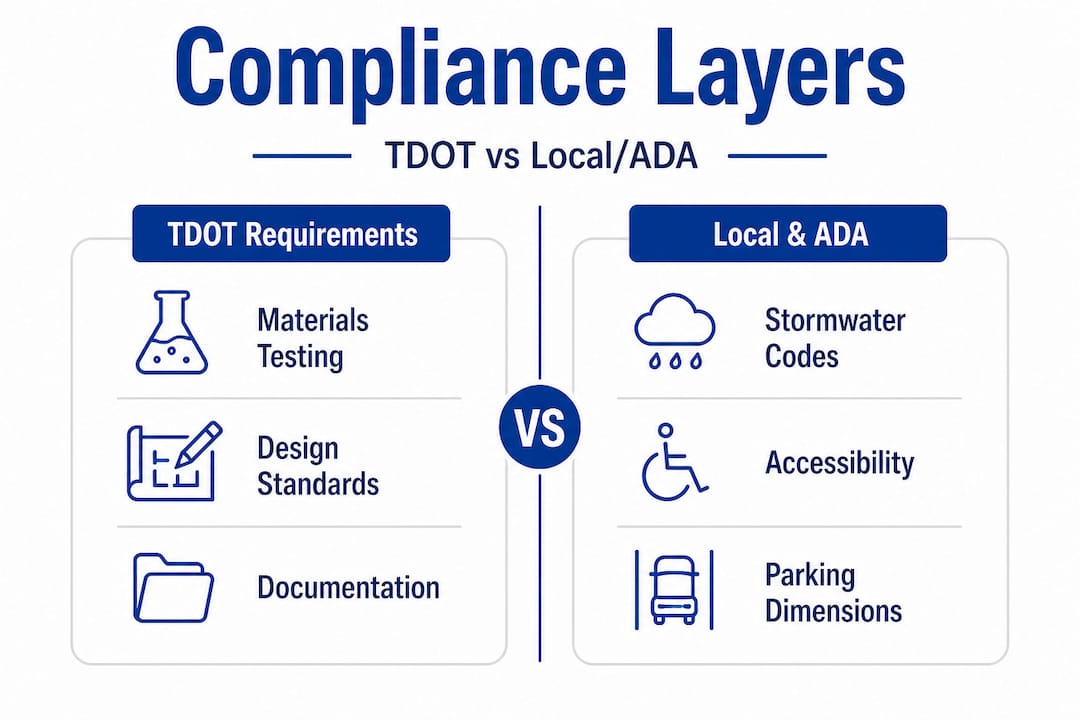
Here's where municipal overlays get tricky. Your city or county may require stricter stormwater controls than TDOT, different parking layout dimensions, or specific trenching and backfill standards for utility-adjacent paving. None of these are automatic. You have to request the applicable local codes from your municipality before design begins, not after.
The ADA layer adds a separate but equally important dimension. Accessibility standards require specific striping dimensions for accessible parking spaces, precise slope limits on accessible routes (generally no steeper than 2% cross-slope), compliant curb ramps with detectable warning surfaces, and smooth transitions between pavement types. These aren't design preferences. They're federal legal requirements that apply regardless of whether your project ever touches TDOT jurisdiction.
Here's how common requirements compare across frameworks:
| Requirement | TDOT minimum | Local/ADA variation |
|---|---|---|
| Accessible parking stall width | Follows state geometry | ADA requires 8 ft. minimum, 8 ft. access aisle |
| Curb ramp slope | Per state design manual | ADA maximum 8.33% running slope |
| Cross-slope on accessible routes | State standard | ADA maximum 2% |
| Stormwater runoff management | TDOT standard | Local may require additional BMPs |
| Parking layout spacing | State minimum | Local zoning may require more |
As the TDOT pavement design framework reinforces, accessibility and safety obligations interact directly with grading, transitions, curb ramps, sidewalks, and route surfaces. These aren't separate checklists — they're integrated design considerations.
Pro Tip: Walk your site with an ADA checklist before any paving or striping begins. Issues with cross-slopes or ramp grades are much cheaper to correct in design than after installation.
For property owners navigating pavement marking and ADA standards, the details matter. Van-accessible spaces, access aisle placement, and route connectivity all feed into the final compliance picture. Larger facilities with multiple access points or roadway ADA compliance obligations have even more to coordinate. And for parking lot operators specifically, ADA obligations for parking lots extend beyond just painting a blue line — they involve surface grade, signage height, and accessible route continuity throughout the lot.
QA/QC, traffic inputs, and why benchmarking matters for long-term performance
Compliance isn't just about passing inspection on day one. It's about building pavement that performs under your actual conditions for the full expected service life. That's where QA/QC and traffic benchmarking become tools for long-term cost control, not just regulatory checkboxes.
Tennessee uses a mechanistic-empirical (ME) pavement design approach, which means structural decisions are driven by measured inputs: traffic volume, axle load distribution, climate data, and subgrade conditions. Tennessee-specific UT/TDOT/FHWA research compiles local traffic data including AADT (Annual Average Daily Traffic) and WIM (Weigh-in-Motion) measurements to directly inform ME design inputs and performance-graded (PG) asphalt binder selection.
Why does that matter to a commercial property owner? Because generic pavement specs don't account for your specific traffic mix. A franchise distribution center with heavy daily truck deliveries loads pavement very differently than a retail parking lot with passenger vehicles. If your contractor designs or rehabilitates your pavement using default national assumptions instead of your actual truck factors, you may end up with an underdesigned structure that fails prematurely.
Tennessee-specific traffic research confirms that truck factor assumptions and traffic characterization can significantly change ME structural number (SN) estimates and PG binder selection. Owners managing high-truck zones should insist on site-specific traffic characterization, not one-size-fits-all assumptions.
Here's a practical approach to demanding better documentation from your contractor or engineer:
- Request a site traffic assessment. Ask how they determined the design traffic (ESAL or axle loads) for your specific location.
- Confirm PG binder selection. The performance grade of your asphalt binder should match both Tennessee's climate and your traffic loading, not just a regional default.
- Ask for verification sampling records. QA/QC documentation should include test results from your specific project, not generic batch sheets.
- Clarify warranty triggers. Understand what test thresholds determine acceptance versus rejection of materials on your job.
- Get the QC plan in writing. Your contractor's quality control plan should be a project-specific document, not a generic company template.
Bottom line: Pavement that is designed and verified with site-specific local traffic data for pavement inputs consistently outperforms generically designed pavement over a 15 to 20 year lifecycle. Cutting corners on QA/QC documentation saves nothing if it leads to early failure and full-depth rehabilitation costs.
For facilities that handle significant freight or fleet traffic, the material standards for asphalt pavement selection is one of the most important decisions in the entire project. Getting it right from the start is the most cost-effective move you can make.
What most owners and operators get wrong about pavement standards
Here's the uncomfortable truth: most commercial property owners are making pavement decisions based on contractor timelines and general maintenance advice, not on the documented, testable requirements that actually define compliance in Tennessee.
There's nothing wrong with following a sealcoat and inspection schedule for routine upkeep. But when your project involves new construction, structural rehabilitation, access changes, or ADA upgrades, that level of guidance falls short. Generic blog advice and contractor recommendation sheets typically focus on "sealcoat every 3 to 5 years" or "inspect in spring and fall." That's maintenance planning, not compliance planning.
TDOT's standard operating procedures are far more specific. They define acceptance testing criteria, QA/QC sampling and verification frequency, measured pay factors, and testing methodology — all of which determine whether a pavement project is legally accepted or not. The gap between "the contractor said it looks good" and "the project passed documented verification sampling" is where compliance failures happen.
What we see consistently in real Tennessee project work is that owners ask the wrong question. They ask, "How long will this last?" They should be asking, "What does your QA/QC plan document for this specific project, and how does that tie to acceptance criteria?" One question gets you a sales pitch. The other gets you accountability.
Demanding evidence over assurance is the shift that separates reactive property management from strategic compliance. You can browse real Tennessee project compliance examples to see what proper documentation and execution actually looks like on the ground.
The contractors worth working with will answer your compliance questions in specific terms: materials tested, sampling frequency, PG binder grade, documentation format, and how results are communicated to you as the owner. Vague answers or resistance to documentation requests are signals to keep looking.
Ensure your pavement project meets every standard
Compliance with Tennessee pavement standards isn't a one-time checkbox. It's an ongoing process that starts before the first truck arrives and continues through documented verification, striping, and signage.
Pinnacle Pavement Solutions works with commercial property owners and franchise operators across Tennessee on every layer of this process — from asphalt paving compliance and site-specific QA/QC documentation to ADA marking solutions that meet both federal requirements and local code overlays. Whether you're managing a new build, a parking lot rehab, or an accessibility upgrade, the team at Pinnacle brings the technical knowledge and drone-documented results to ensure your project holds up to scrutiny. Ready to take the next step? Consult with pavement experts who understand what compliance actually looks like in Tennessee.
Frequently asked questions
What is the difference between pavement standards and typical maintenance suggestions?
Pavement standards are jurisdiction-defined requirements covering design, testing, materials acceptance, and safety, while maintenance suggestions are general best-practice timelines. TDOT's documented procedures include specific acceptance, QA/QC sampling, and pay criteria that go well beyond a seasonal inspection schedule.
Do all commercial pavement projects in Tennessee have to meet TDOT standards?
Not all projects require full TDOT compliance. Private or small-scale projects may primarily follow local or ADA standards, but projects involving public access, state right-of-way, or major commercial development often must meet TDOT criteria across design, materials, and QA/QC.
How does ADA compliance affect pavement requirements?
ADA compliance adds legally required minimums for accessible parking dimensions, route cross-slopes, curb ramp grades, and detectable surface treatments that must be integrated with both state and local pavement codes, not treated as a separate add-on.
Why does Tennessee use local traffic data in pavement design?
Local axle load and traffic volume data allows for site-specific structural design and PG binder selection. Tennessee-specific research shows that using local traffic characterization produces more accurate mechanistic-empirical pavement designs that perform longer under actual site conditions.