
When a contractor hands you a proposal full of terms like "HMA overlay," "tack coat application," or "open-graded surface course," it's easy to nod along without fully understanding what you're agreeing to pay for. For commercial property owners and franchise operators in Tennessee, that confusion is more than a minor inconvenience. It can lead to mismatched treatments, budget overruns, and surfaces that fail far sooner than they should. This guide cuts through the jargon and gives you the plain-language definitions and decision-making context you actually need.
Table of Contents
- Core asphalt mixture terms: HMA, WMA, gradation, and course types
- Understanding binder, emulsion, and material streams
- Surface distress terms: Identifying causes for better maintenance decisions
- Overlay and sealcoat vocabulary: Project scope and contractor proposals
- What most guides miss: Connecting terminology to real-world decisions
- Need expert help? Connect with Southeast's top asphalt pros
- Frequently asked questions
Key Takeaways
| Point | Details |
|---|---|
| Clear definitions drive better decisions | Knowing what asphalt terms mean lets you choose the right maintenance solution with confidence. |
| Binder and emulsion impact project quality | Understanding these materials helps ensure correct paperwork and reduces ambiguity in Tennessee contracts. |
| Distress terms inform treatment choices | Identifying the cause behind surface issues avoids wasted money on the wrong repairs. |
| Overlay and sealcoat vocabulary matters | Recognizing the distinctions in project scope helps you evaluate contractor bids accurately. |
Core asphalt mixture terms: HMA, WMA, gradation, and course types
Let's start at the foundation. Asphalt pavement is not a single material. It's a system of engineered layers, each built from specific mixtures designed for specific purposes. When you see terms in contractor proposals or TDOT documentation, they're referring to distinct components of that system.
Hot-mix asphalt (HMA) is the most widely used mixture type in Tennessee. It's produced at temperatures between 275°F and 325°F, which keeps the binder fluid enough to coat the aggregate particles evenly. Warm-mix asphalt (WMA) uses additives, foaming processes, or chemical treatments to reduce production temperatures by roughly 50°F to 100°F. According to the Asphalt Paving Handbook, pavement layers and mixture naming commonly align with HMA and WMA types, course names, and mix classification by aggregate gradation. WMA is gaining ground in Tennessee because it reduces fuel consumption, extends paving seasons, and lowers worker exposure to fumes.
Course types describe where each layer sits in the pavement structure:
- Base course: The bottom structural layer, built for load-bearing capacity. Uses larger, coarser aggregate.
- Intermediate course: Sits between base and surface, distributing load and providing additional structural support.
- Surface or wearing course: The top layer that contacts traffic. Designed for smoothness, friction, and weather resistance.
Gradation refers to how aggregate particle sizes are distributed in the mix:
- Dense-graded: Tightly packed mix with very few air voids. Great for general use parking lots and driveways.
- Open-graded: High void content that allows water drainage. Common in permeable pavement applications.
- Gap-graded: Skips certain particle sizes, creating a coarser, more textured surface. Used for specific friction or drainage applications.
| Mix type | Air void range | Typical use case |
|---|---|---|
| Dense-graded HMA | 3% to 5% | Parking lots, commercial drives |
| Open-graded HMA | 15% to 20% | Permeable surfaces, drainage areas |
| Gap-graded HMA | 6% to 12% | High-friction roadway surfaces |
| WMA (dense) | 3% to 5% | Eco-sensitive or extended-season paving |
Understanding these classifications matters when reviewing your asphalt services proposal. If a contractor quotes a surface course but your parking lot needs a base rebuild, those are completely different scopes of work at very different price points. Knowing the vocabulary keeps you from comparing apples to oranges across multiple bids. Mix classification also affects longevity. A surface course specified with the wrong gradation for Tennessee's freeze-thaw cycles will show distress in two to three years instead of seven to ten.
For properties with marked roadways, it's also worth knowing that surface course specifications can affect how well thermoplastic markings bond to the pavement. Coarser, open-graded surfaces require different application approaches than smooth, dense-graded ones.
Understanding binder, emulsion, and material streams
Once you understand mixture types, the next layer of vocabulary involves what holds the mix together. This is where a lot of confusion creeps into contractor conversations, particularly around the words "binder," "cement," and "emulsion."
Asphalt cement is the thick, petroleum-derived binder that coats and glues aggregate particles together in a hot-mix. It's graded using a Performance Grade (PG) system. Tennessee's climate typically requires binders rated to handle both summer heat and winter cold, often PG 64-22 or PG 76-22 for high-traffic areas. The grade numbers reflect temperature performance thresholds, so a PG 76-22 binder handles hotter pavement temperatures without rutting.
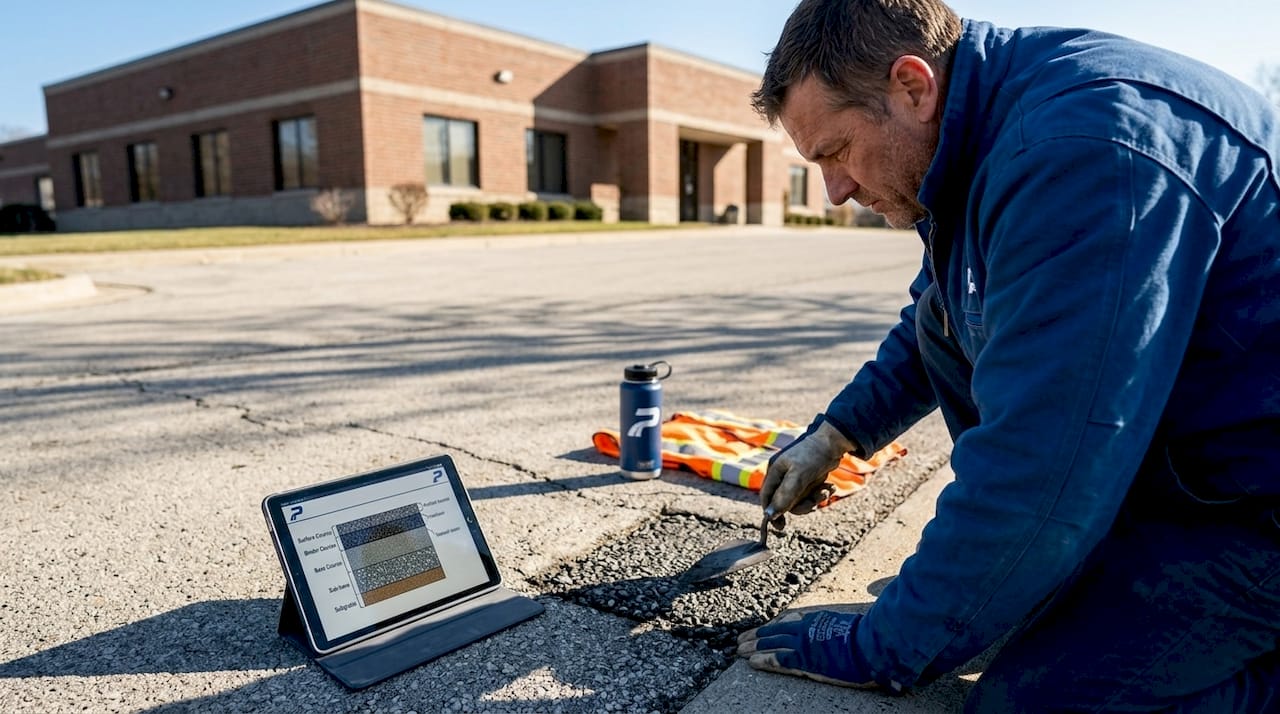
Asphalt emulsion is a liquid product where asphalt cement is suspended in water using an emulsifying agent. It's used cold, which makes it ideal for tack coats, fog seals, and some chip seal applications. It breaks or "sets" as the water evaporates, leaving the asphalt residue behind.
Asphalt mix is the combined finished product: binder plus aggregate, ready to be placed and compacted.
In Tennessee, TDOT standard operating procedures treat asphalt cement, asphalt emulsion, and asphalt mix as separate materials streams with distinct sampling and paperwork requirements. This is more than administrative detail. It means that a delivery ticket for asphalt cement is not the same as a ticket for asphalt mix. If your contractor's documentation doesn't match the material being placed, you have a quality control gap that could void warranties or compliance certifications.
Here's a practical numbered framework for how these terms apply when reviewing contractor proposals:
- Identify the material stream. Is the project using asphalt cement (hot-mix), emulsion (cold-applied), or finished mix? Each has a different delivery process and inspection protocol.
- Ask for the PG grade. For any project involving new paving, confirm the binder performance grade matches Tennessee's climate zone for your specific location.
- Request delivery tickets. Each load of material should be accompanied by documentation that identifies the product type, supplier, and batch information.
- Verify emulsion type for surface treatments. Cationic and anionic emulsions behave differently and are not interchangeable. The wrong type on your surface can cause adhesion failures.
- Confirm the tack coat emulsion rate. Over-application creates a slick layer between lifts. Under-application causes delamination. Both are preventable with the right documentation.
Pro Tip: When you get a bid that just says "apply tack coat," ask the contractor to specify the emulsion type and application rate in gallons per square yard. That single question will tell you a lot about whether you're dealing with a detail-oriented crew or someone who's cutting corners on documentation.
These distinctions also matter for franchise operators who work with roadway marking or drive-thru layout requirements. If the surface material stream isn't correctly documented, restriping schedules and ADA compliance timelines get harder to track.
Surface distress terms: Identifying causes for better maintenance decisions
This is the vocabulary that most directly affects your maintenance budget. When you can name what's happening to your pavement and understand what caused it, you stop throwing money at symptoms and start treating actual problems.
Flushing and bleeding describe the same phenomenon: excess liquid asphalt binder migrating to the surface, creating a shiny, greasy appearance. It usually signals an over-rich mix design, too much tack coat between layers, or binder that has softened due to heat. The critical concern is friction loss. A flushed surface becomes dangerously slick in wet conditions. According to the TXDOT Pavement Manual, flushing terminology signals excess binder content or shot-rate problems, representing a direct surface friction risk.
Raveling is the progressive loss of aggregate particles from the surface, starting with small pieces and eventually exposing the underlying layer. It typically signals binder hardening, aging, or inadequate compaction during original placement. Raveling is a strong indicator that the surface is ready for protective treatment, often sealcoating, before the problem penetrates deeper.
Cracking is not a single condition. It includes several distinct types:
- Fatigue or alligator cracking: Interconnected cracks resembling reptile skin. Signals structural failure from repeated loading. Sealcoating will not fix this.
- Longitudinal cracking: Long cracks running parallel to the centerline. Often caused by joint construction failures or pavement edge movement.
- Transverse cracking: Cracks perpendicular to the centerline, typically caused by thermal cycling and binder hardening.
- Reflective cracking: Surface cracks that mirror the pattern of cracks in an underlying layer. Common after overlays are placed over deteriorated pavement.
| Distress type | Primary cause | Appropriate treatment |
|---|---|---|
| Flushing/bleeding | Excess binder or application | Sand blotting, friction course |
| Raveling | Binder aging, poor compaction | Sealcoat, surface rejuvenator |
| Alligator cracking | Structural failure | Full-depth repair, base rebuild |
| Transverse cracking | Thermal cycling | Crack sealing, surface overlay |
| Reflective cracking | Weak underlying layer | Milling, interlayer fabric |
Pro Tip: If a contractor recommends sealcoating over alligator cracking, push back. Sealcoat is a preventive and surface protection tool, not a structural repair. The cracks will reflect back through a sealcoat within one season.
Knowing these distinctions helps you avoid two common and expensive mistakes: paying for structural repairs when a surface treatment would have worked, and paying for surface treatments when the problem is structural and will return regardless.
Overlay and sealcoat vocabulary: Project scope and contractor proposals
Overlay and sealcoat terminology is where the biggest budget misunderstandings happen between property owners and contractors. These terms define the entire scope and intent of a project.
Tack coat is a thin application of asphalt emulsion applied to an existing pavement surface before a new layer is placed. Its sole purpose is to create a bond between the old and new layers. Without it, the new layer can slide under traffic loads.
Seal coat (also written as sealcoat) is a thin protective coating applied to an existing asphalt surface. It's not structural. It protects against oxidation, moisture intrusion, and surface wear. The Asphalt Institute Glossary makes clear that overlay-related terms indicate whether a project is primarily bonding a lift, providing surface protection, or restoring structural capacity. These are three fundamentally different things.
Maintenance overlay refers to a thin layer of new asphalt placed over an existing surface to restore smoothness, improve friction, or extend service life. It does not add meaningful structural capacity.
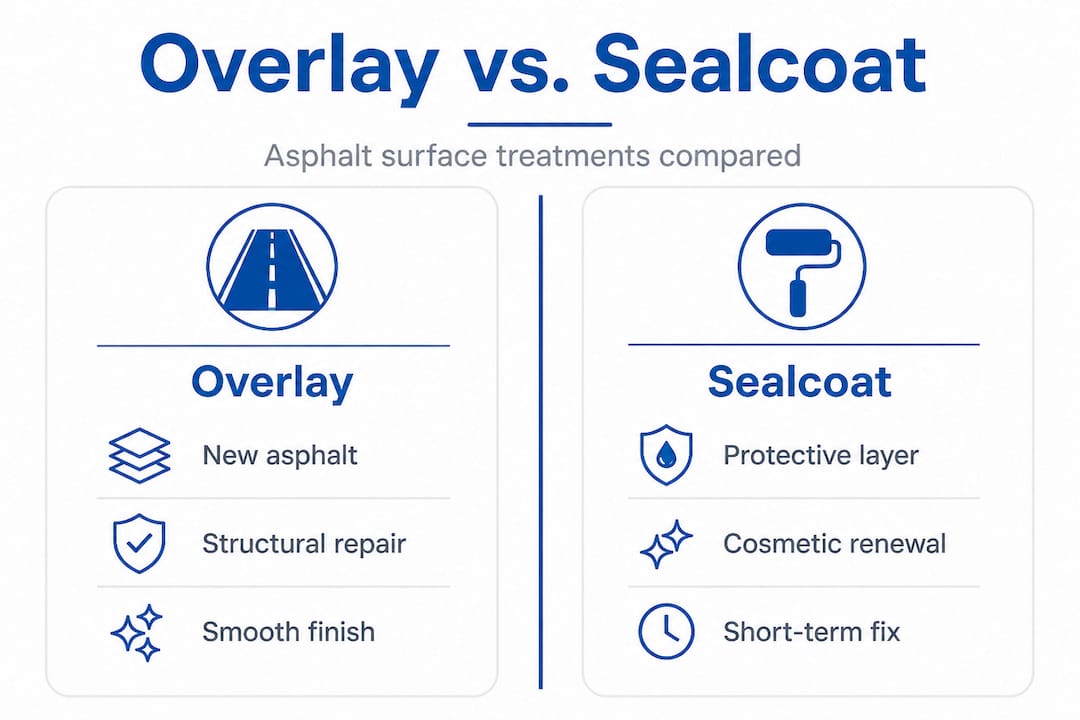
Structural overlay is a thicker application designed to restore load-bearing capacity to a deteriorated pavement section. It requires careful design, milling of the existing surface, and proper tack coat application.
Here's how to use this vocabulary when reviewing bids:
- Ask whether the proposed overlay is structural or maintenance. The answer tells you if the contractor is treating the root cause or just the surface.
- Confirm tack coat is specified as a separate line item. If it's not, ask why.
- Understand the overlay thickness. Maintenance overlays typically range from 1.5 to 2 inches. Structural overlays often exceed 3 inches.
- Clarify what happens to existing cracks. Will they be sealed before the overlay? Milled out? Left in place?
"Understanding whether your project is a bonding application, a surface protection treatment, or a structural restoration will prevent you from accepting a lower-cost proposal that doesn't actually solve the problem."
Choosing between a sealcoat and resurfacing is one of the most common decisions commercial owners face. The detailed breakdown in our sealcoat versus resurfacing guide lays out the cost and performance tradeoffs clearly. And when you're ready to schedule sealcoating, knowing this vocabulary means you can hold your contractor accountable to the right scope.
What most guides miss: Connecting terminology to real-world decisions
Here's the honest perspective: most asphalt terminology guides treat vocabulary as an end in itself. Learn the word, know what it means, move on. That approach is useful up to a point, but it misses the real value these terms offer to property owners and franchise operators.
Asphalt terminology is most useful when you treat it as a cause-to-treatment map. Every distress term describes a cause or a failure mechanism. Every material term describes a solution type with specific performance characteristics. When you connect them, you stop reacting to surface problems and start making proactive, systematic maintenance decisions.
Here's an example. A franchise operator sees dark, shiny patches in the drive-thru lane. Without knowing the vocabulary, they ask for "whatever fixes the shiny spots." A contractor might quote a sealcoat job. But if the property owner recognized those patches as flushing or bleeding, they would know the root cause is excess binder, and a sealcoat would not solve it. In fact, it could make the friction problem worse.
The same logic applies to overlay decisions. If you hear "structural overlay" but the distress is purely cosmetic raveling, you're being upsold. If you accept a "maintenance mix" when the base has failed, you're throwing money at a surface while the real problem continues underground.
We've seen Tennessee commercial properties cycle through surface treatments every two to three years because the original diagnosis was wrong. The pavement failed not because the contractor did bad work, but because the scope was defined by the wrong terms. Connecting the vocabulary from our sealcoat versus resurfacing guide to the distress types described in this article is exactly how you prevent that cycle.
Property owners who understand these terms ask better questions, get more accurate bids, and hold contractors to clearly defined scopes. That's a direct return on the time spent learning the vocabulary.
Need expert help? Connect with Southeast's top asphalt pros
Understanding the terminology is the first step. Applying it to a real property with real conditions, traffic loads, and budget constraints requires someone who works in this space every day.
Pinnacle Pavement Solutions works with commercial property owners and franchise operators across Tennessee to assess pavement conditions accurately, communicate in plain language, and deliver treatments that match the actual problem. Whether you're trying to figure out if your parking lot needs a sealcoat or a full overlay, or you want a second opinion on a contractor proposal, we bring the expertise and the documentation to back every recommendation. Visit Pinnacle Pavement Solutions to explore what we do, review our professional asphalt services, or schedule a walkthrough with our team. Honest assessments, drone-documented results, and no unnecessary upsells.
Frequently asked questions
What is the difference between HMA and WMA in asphalt terminology?
Hot-mix asphalt (HMA) is produced at higher temperatures to keep the binder fluid during mixing and placement, while warm-mix asphalt (WMA) uses additives or processes to lower production temperatures by 50°F to 100°F. Both are main mixture types in TDOT documentation, with WMA offering environmental and seasonal advantages.
Why does overlay terminology matter for my property maintenance budget?
Knowing whether a proposed overlay is structural or a maintenance treatment tells you if the project addresses the root cause of your pavement failure or just the surface appearance. The Asphalt Institute Glossary confirms that overlay terms indicate the scope and intent of the project, which directly affects how long the results will last.
How can knowing binder or emulsion types improve project quality?
Specifying the correct binder performance grade and emulsion type ensures the materials match your climate zone and surface conditions, which prevents premature failures. In Tennessee, TDOT documentation treats binder and emulsion as separate materials with distinct paperwork requirements, so correct identification also supports quality control compliance.
What does "raveling" signal about surface condition?
Raveling means the pavement surface is losing aggregate particles due to binder aging or inadequate original compaction, signaling it's ready for protective treatment before deeper damage occurs. According to the TXDOT Pavement Manual, raveling signals aggregate and binder loss that requires surface protection approaches rather than structural repairs.