
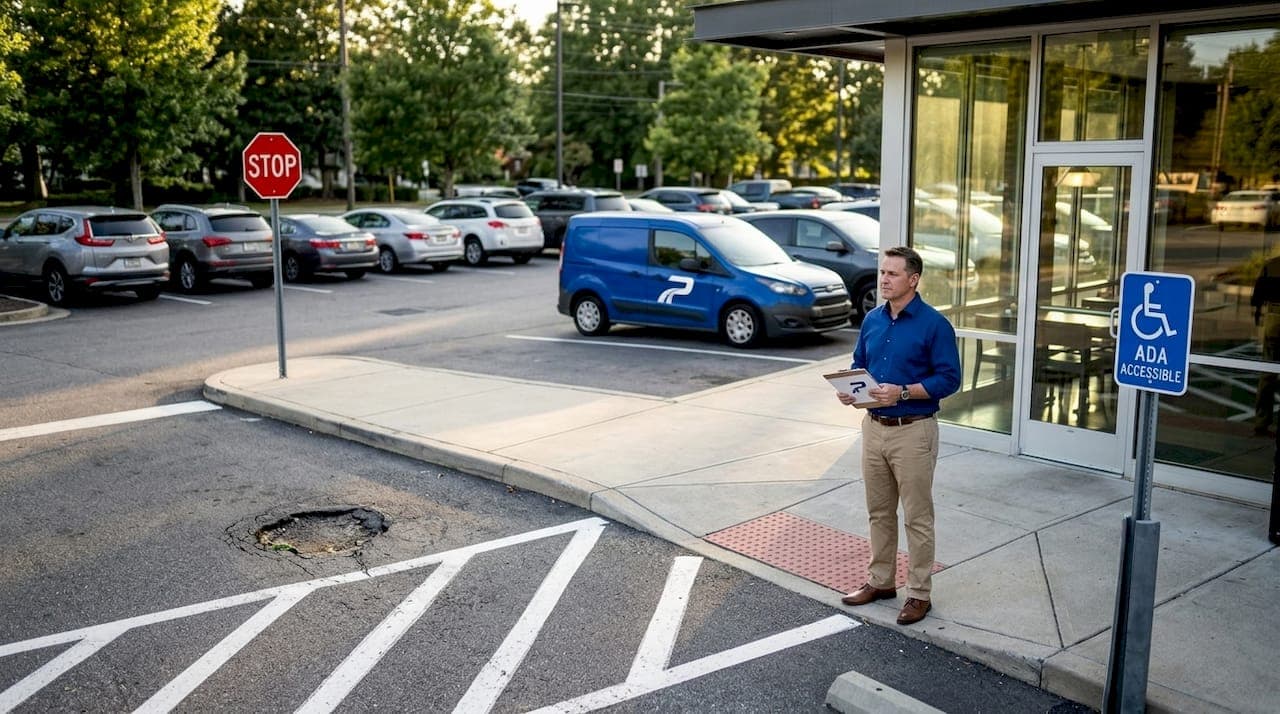
Running a franchise in Tennessee means your parking lot works harder than most people realize. It is the first thing customers see, the first compliance risk your franchisor or a federal inspector will flag, and one of the most expensive deferred maintenance problems in commercial property management. Addressing franchise parking lot needs before they become violations or pavement failures requires understanding ADA law, parking ratios, surface materials, and Tennessee's specific environmental rules. This article covers all of it, in the order you need to act on it.
Table of Contents
- Key criteria for franchise parking lot design and maintenance
- Essential parking lot features for franchise accessibility and compliance
- Comparing parking lot pavement options for longevity and functionality
- Planning and prioritizing parking lot upgrades for Tennessee franchises
- Why restriping is the best time to tackle franchise parking lot needs
- Expert pavement solutions for your franchise parking lot needs
- Frequently asked questions
Key Takeaways
| Point | Details |
|---|---|
| ADA compliance matters | Provide properly striped and signed accessible parking spaces and routes to meet legal standards. |
| Parking impacts sales | Adequate parking ratios tailored to franchise type enhance customer convenience and frequency. |
| Maintenance aids compliance | Use restriping events as opportunities to correct accessibility issues and boost curb appeal. |
| Choose durable surfaces | Select pavement and coatings that balance longevity, aesthetics, and regulatory requirements. |
| Plan upgrades strategically | Prioritize accessibility fixes, then aesthetics, integrating Tennessee environmental practices. |
Key criteria for franchise parking lot design and maintenance
Franchise parking lots explained simply: they must be functional, compliant, and built to last. That sounds obvious, but most owners underestimate how many overlapping requirements shape what a good lot actually looks like.
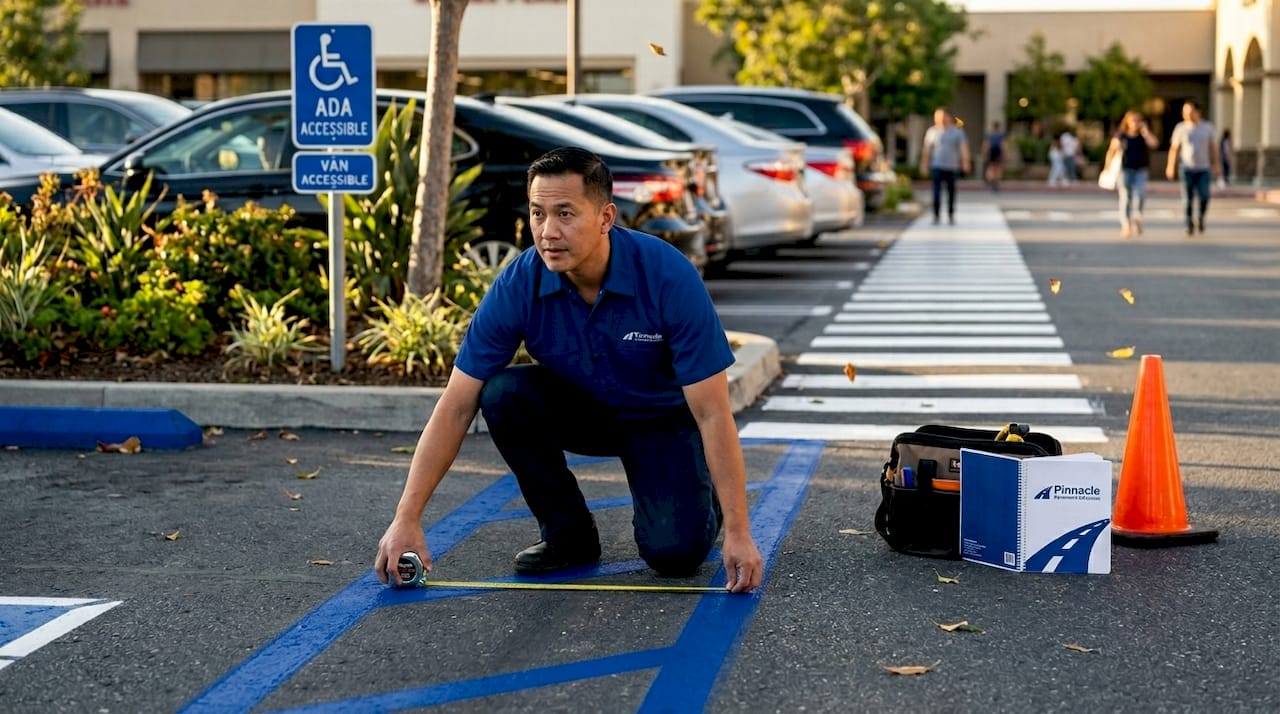
ADA compliance is non-negotiable and has a specific technical standard behind it. ADA parking requirements are defined by the 2010 ADA Standards, which spell out accessible space counts, dimensions, access aisle widths, surface slopes, and signage specifications. A lot that was compliant five years ago may not be today if lines have faded, signs are missing, or a prior contractor misstriped the access aisle. Our guide to ADA parking compliance in Tennessee walks through the specifics for local property owners.
Parking ratios directly affect your sales. Parking availability is a formal site selection factor for many franchise systems, with guidelines that vary by franchise type. A fast-food location needs different turnover capacity than a fitness studio or a hair salon. If your lot is undersized for your customer volume, you are losing revenue, period.
Stormwater and erosion control matter more than most franchise owners expect. Tennessee's Stormwater BMP manual provides guidance on managing soil erosion and water quality during parking lot construction and repair. Any time you repave or significantly resurface, you may trigger stormwater compliance obligations. Ignoring this can delay projects and create liability.
Surface durability ties everything together. A lot that cracks, heaves, or develops potholes fails customers and compliance at the same time. Understanding pavement durability and curb appeal from the outset saves money over the life of your property.
Here is what a full compliance and durability review of franchise parking lot requirements should cover:
- Total space count and required accessible space ratio
- Van-accessible space designation and proper signage height
- Access aisle dimensions and surface cross-slope
- Surface condition: cracking, drainage, and trip hazards
- Striping visibility and color contrast
- Stormwater runoff pathways and erosion points
- Pavement age and maintenance history
Essential parking lot features for franchise accessibility and compliance
Once you know the criteria, the next step is understanding exactly what the physical lot must contain. This is where franchise parking solutions move from paperwork to asphalt.
Accessible parking spaces must be correctly striped and signed. The stripe color, the "NO PARKING" marking in the access aisle, the international symbol of accessibility on the pavement and on a sign mounted at the front of the space: all of these are required, not optional. Van-accessible parking adds another layer. These spaces require a minimum 98-inch vertical clearance for covered structures and an access aisle that is at least 96 inches wide rather than the standard 60 inches.
Many of the most common ADA violations at franchise parking lots are surprisingly simple to fix: a missing access aisle, a sign mounted at the wrong height, or a space that was striped to the right dimensions but in the wrong location relative to the accessible entrance. These are inexpensive corrections when caught during a planned maintenance project. They become expensive when they are caught by a complaint or an inspector.
Here is what every franchise lot's accessible parking section must include:
- Clearly striped accessible stalls with correct width
- A striped access aisle adjacent to every accessible space
- At least one van-accessible space per six accessible spaces
- Mounted signage with the accessibility symbol at 60 inches minimum height
- A paved, slope-controlled accessible route connecting the space to the building entrance
- No obstacles, lip transitions, or drainage grates in the accessible route
Pro Tip: When you schedule any striping work, hand your contractor a copy of your current accessible space layout and ask them to flag anything that does not meet current ADA dimensions before they touch a single line. That five-minute review can prevent a $75,000 lawsuit.
Full ADA compliance requires more than counting spaces. The accessible route from the parking lot to your entrance is evaluated separately and must be free of surface defects, cross-slopes over 2%, and obstructions. Your parking lot striping solutions should account for the entire path, not just the stall.
Comparing parking lot pavement options for longevity and functionality
Franchise space planning often focuses on the building footprint and ignores pavement material selection. That is a mistake. The surface you choose, and how you maintain it, determines both your compliance durability and your brand appearance for the next decade.
| Pavement option | Typical lifespan | Cost level | ADA compliance ease | Curb appeal impact |
|---|---|---|---|---|
| Full asphalt paving | 20 to 30 years | High upfront | High with proper layout | High when new |
| Sealcoating | Extends base 3 to 5 years per application | Low | Neutral (preserves existing) | High, restores dark color |
| Crack filling and repair | Varies by damage | Low to medium | Medium (removes trip hazards) | Medium |
| Epoxy coatings | 5 to 10 years on concrete | Medium | High with correct markings | Very high |
| Restriping only | Depends on paint quality | Low | High when done correctly | High |
Sealcoating and pavement maintenance extend lot life and improve curb appeal for Tennessee properties. That is not marketing: a properly sealed lot resists oxidation from Tennessee's summer UV exposure, repels fuel and oil spills that degrade asphalt binders, and gives your property the clean, dark appearance that communicates professionalism to every customer pulling in.
Key points on each option:
- Asphalt paving: The foundation of any quality lot. Full-depth paving gives you a fresh start on layout, drainage, and ADA design. Tennessee asphalt basics explain why base preparation matters as much as the surface mix.
- Sealcoating: Applied every two to three years, sealcoating services protect your investment and cost a fraction of repaving.
- Epoxy coatings: More common for covered parking or drive-thru aprons, epoxy adds grip, chemical resistance, and a finished appearance.
- Restriping: The most frequently needed service and the one most often done without an ADA review. Parking lot striping done correctly covers dimensions, color contrast, and accessible route markings in one pass.
Pro Tip: In Tennessee, sealcoating in late summer or early fall before temperatures drop below 50 degrees gives the sealer adequate cure time and sets your lot up for the following spring inspection season in the best possible condition.
Planning and prioritizing parking lot upgrades for Tennessee franchises
Efficient parking for franchises does not happen by accident. It requires a deliberate upgrade sequence that puts compliance first and aesthetics second, not because appearance does not matter, but because ADA fixes that get buried under fresh paint and seal tend to get forgotten.
Here is a practical framework for how to sequence your parking lot improvements:
- Conduct a baseline audit. Walk the lot with a tape measure and your current striping layout. Identify every accessible space, measure the access aisles, check signage heights, and document surface defects. Note any drainage problems.
- Fix ADA and safety items first. ADA accessibility should be treated as a compliance checkpoint during restriping, not just an aesthetic refresh. Address any missing spaces, misstriped aisles, or absent signage before scheduling cosmetic work.
- Address structural surface problems. Crack fill, patch potholes, and repair edge damage. Sealcoating over cracked pavement seals cracks in temporarily but does not stop their growth.
- Apply sealcoating and restripe. Pair curb appeal projects with ADA audits to prevent repeat fixes. Do both in the same project cycle so you are not paying for mobilization twice.
- Install or replace signage. Post-mounted ADA signs, directional signs, and drive-thru lane markers should all be verified and updated at the same time.
- Review stormwater controls. If your project involves any significant paving or grading, confirm that your work aligns with Tennessee environmental standards before you break ground.
- Schedule future maintenance cycles. Striping best practices include planning for restriping every two to three years and sealcoating on the same or adjacent cycle to keep costs predictable.
Franchise car park needs change as franchise systems update their brand standards and as parking lot surfaces age. Building a documented maintenance schedule means you are never caught off guard by a franchisor audit or a customer complaint.
Why restriping is the best time to tackle franchise parking lot needs
Here is something most pavement contractors will not tell you, either because they do not know ADA law or because they want to keep the scope of work narrow: every time you restripe a parking lot, you are legally obligated to review and improve accessible parking if it is readily achievable. That is not an interpretation. Restriping triggers ADA obligations for accessible parking updates and barrier removals. "Readily achievable" is a legal standard that covers most line corrections and sign installations. It is a low bar intentionally.
What this means practically is that restriping is not a maintenance task you can separate from compliance. Property managers who treat them as separate projects are creating liability twice: once by failing to maintain the lot, and once by completing a restripe that leaves ADA deficiencies in place.
The smarter approach: build ADA compliance during restriping into your contractor specifications from the start. Require that any crew doing striping work also verify space counts, access aisle dimensions, signage, and accessible route surfaces. Document what was checked and what was corrected. That documentation is your protection if a complaint is ever filed.
We have seen Tennessee franchise owners spend money on fresh sealcoating and bright new stripes, only to get a complaint letter three months later because a van-accessible space was misstriped and the sign was mounted four inches too low. The fix was inexpensive. The process of responding to the complaint was not. Proactive management of best practices for franchise parking is not just about compliance. It is about protecting the investment you are already making in your property.
Expert pavement solutions for your franchise parking lot needs
Your franchise's parking lot is a direct reflection of your brand, and Pinnacle Pavement Solutions understands what Tennessee franchise owners are up against.
We handle the full scope of franchise parking lot work: from parking lot striping services that meet ADA dimensional requirements to sealcoating services that restore and protect your asphalt surface, to epoxy floor coatings for drive-thru aprons and covered parking. Every project is documented with drone photography, priced honestly, and executed with professional-grade equipment. If your lot needs a compliance review, a full repave, or just fresh lines and a new seal, we bring the expertise to do it right the first time so you are not calling us back to fix a problem in six months.
Frequently asked questions
How many accessible parking spaces are required for franchise lots?
The number of required accessible spaces scales with total lot size: one accessible space per 25 total spaces is the starting ratio, and at least one of every six accessible spaces must be van-accessible.
What are common ADA violations in franchise parking lots?
The most cited violations involve missing access aisles, incorrect striping dimensions, signs mounted at the wrong height, and accessible spaces placed too far from the building entrance. Most are inexpensive to correct during scheduled maintenance.
How often should ADA features in parking lots be inspected?
Franchise owners should run at least an annual ADA self-assessment covering accessible spaces, access aisles, signage, and the full accessible route from the lot to the building entrance.
Can restriping improve ADA compliance?
Yes, and it is legally required to do so when accessible parking improvements are readily achievable. Restriping triggers compliance obligations under the ADA, making it the most cost-effective moment to correct accessible parking deficiencies.
What Tennessee-specific concerns affect parking lot upgrades?
Stormwater management and erosion control are the two biggest local factors. Tennessee's Stormwater BMP manual outlines best practices for managing water quality and soil erosion during any paving project, and compliance is required when work affects impervious surfaces.