
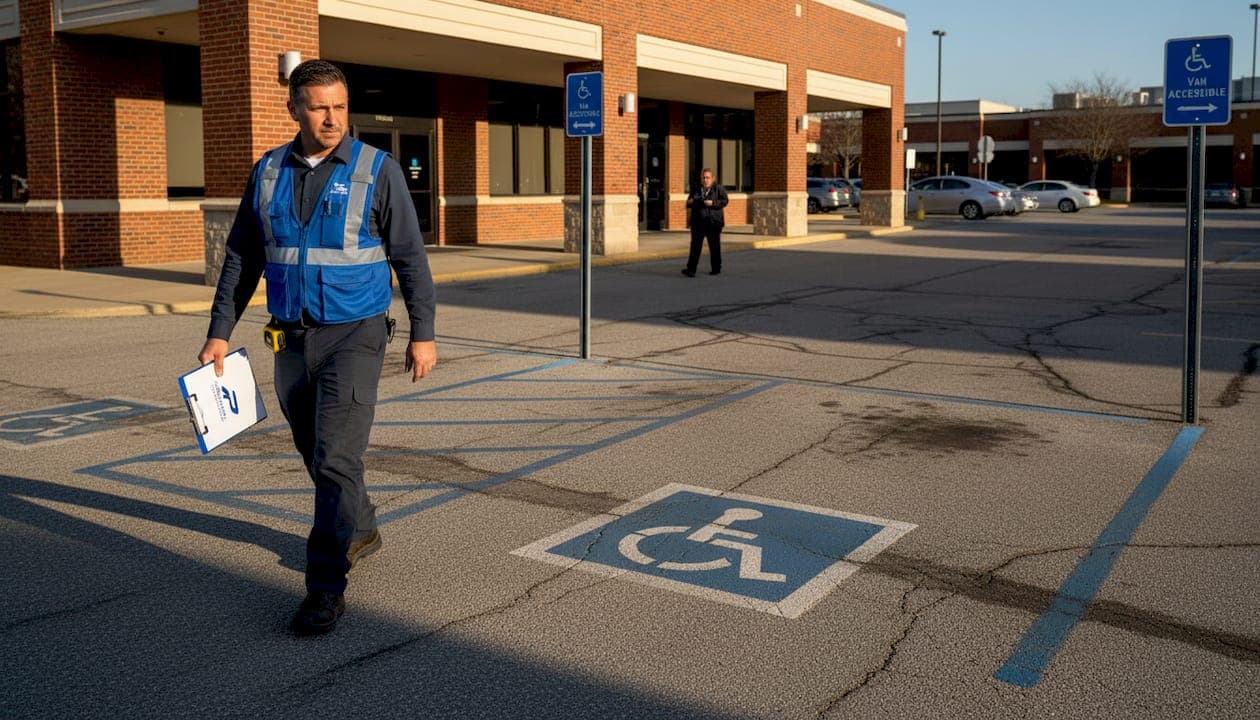
Most Tennessee commercial property owners think ADA parking compliance is straightforward: slap up a blue sign, paint a wheelchair symbol on the pavement, and call it done. That assumption costs businesses thousands of dollars in fines and lawsuit settlements every year. True compliance is a precision process governed by specific measurements, space counts, layout rules, and route requirements that go far beyond a couple of signs. This guide walks you through everything you need to know, from calculating required space counts to getting the exact dimensions right, so your property holds up to any inspection or legal challenge.
Table of Contents
- Who must comply with ADA parking regulations?
- How many accessible spaces are required?
- Exact dimensions and layout: ADA benchmarks
- Location, routes, and real-world access
- Resurfacing and restriping: Staying compliant during maintenance
- Expert perspective: Why ADA parking compliance is a measurement-driven process
- Need help ensuring ADA-compliant parking lots?
- Frequently asked questions
Key Takeaways
| Point | Details |
|---|---|
| Accessible space count | Each parking lot must meet minimum ADA space requirements based on its own total spaces. |
| Space and route standards | Car and van-accessible spaces have exact size, clearance, and signage rules, plus the route to entrances must be safe and level. |
| Van-accessible spaces | At least one of every six accessible spaces must be van-accessible with additional width and vertical clearance. |
| Resurfacing triggers obligations | Upgrading, restriping, or resurfacing your lot means you must address ADA space and access requirements if feasible. |
| Physical verification | Checking compliance with tape measures and checklists—not just visual cues—prevents violations. |
Who must comply with ADA parking regulations?
If your property is open to the public in any capacity, the Americans with Disabilities Act applies to you. That covers retail centers, office buildings, medical facilities, restaurants, hotels, warehouses with public access, and even privately owned lots that serve the public. In Tennessee, the rule is no different than the federal standard. There are no state carve-outs that reduce your obligations.
One of the most misunderstood points is the scope of compliance. The ADA requires accessible parking for businesses and covered entities that provide parking lots or garages for the public, and those spaces must comply with the 2010 ADA Standards for Accessible Design under Sections 208 and 502. This applies to each individual lot or garage on your property, not the property as a whole. If you own a strip mall with three separate lots, each lot has its own compliance requirements.
Consequences for non-compliance are serious and very real:
- Federal civil penalties of up to $75,000 for a first violation and $150,000 for repeat violations
- Private lawsuits filed by individuals with disabilities, often resulting in legal fees that dwarf the cost of compliance
- Operational disruptions when a court orders immediate corrective action
- Reputational damage that affects leasing, foot traffic, and business relationships
Review your Tennessee pavement standards to understand how both state and federal requirements interact for commercial property owners.
How many accessible spaces are required?
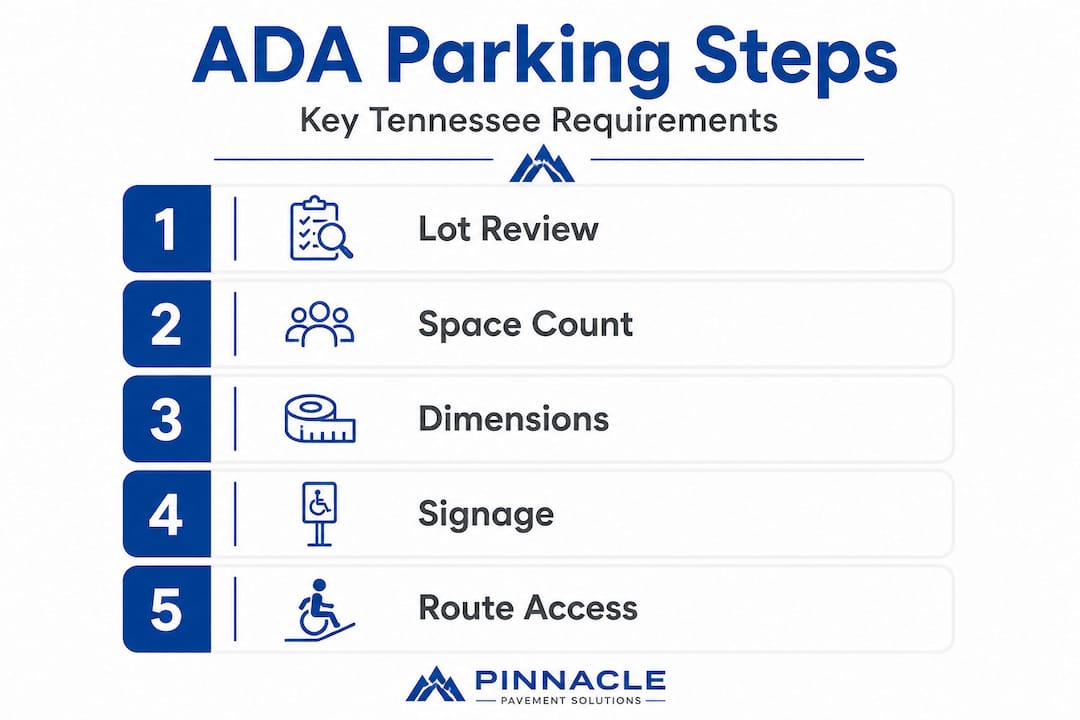
Once you confirm you must comply, the next step is calculating exactly how many accessible spaces each of your lots needs. The formula is based on the total number of spaces in each individual parking facility, not across your entire site.
The minimum accessible spaces required are calculated per facility, not per site. Here is the official breakdown:
| Total spaces in lot | Minimum accessible spaces required |
|---|---|
| 1 to 25 | 1 |
| 26 to 50 | 2 |
| 51 to 75 | 3 |
| 76 to 100 | 4 |
| 101 to 150 | 5 |
| 151 to 200 | 6 |
| 201 to 300 | 7 |
| 301 to 400 | 8 |
| 401 to 500 | 9 |
| 501 to 1,000 | 2% of total |
| 1,001 and over | 20, plus 1 per 100 over 1,000 |
Beyond the accessible space count, you also need van-accessible spaces. At least one in every six accessible spaces must be van accessible. So if your lot requires six accessible spaces total, at least one must meet the full van-accessible standard. If you have only one accessible space, that single space must be van accessible.
Here is a simple way to audit your own lot:
- Count every striped space in the lot, including any existing accessible spaces.
- Use the table above to determine how many accessible spaces are legally required.
- Divide your accessible space total by six to find how many van-accessible spaces you need (round up if needed).
- Physically verify that existing designated spaces actually meet the dimension requirements (covered in the next section).
- Document your findings with photos and measurements before calling a contractor.
Pro Tip: Never count multiple lots together to hit your minimum. A 200-space site with two separate 100-space lots needs four accessible spaces total across both lots, not just four for the site combined. Treat each lot as its own calculation.
If you want to see how proper spacing and layout translate to finished pavement markings, browse our parking lot striping guide for examples of compliant striping layouts.
Exact dimensions and layout: ADA benchmarks
Knowing how many spaces to designate is only half the job. Each designated space must also meet precise dimensional requirements. This is where most properties fail inspections because narrow aisles, low overhead clearances, and missing signage are common and expensive mistakes.
Standard car-accessible spaces must be at least 96 inches wide with an access aisle that is at least 60 inches wide running the full length of the space. That access aisle is not a suggestion; it is the legally required path that allows a person using a wheelchair or mobility device to enter and exit a vehicle safely. Blocking or striping over that aisle is a violation, full stop.
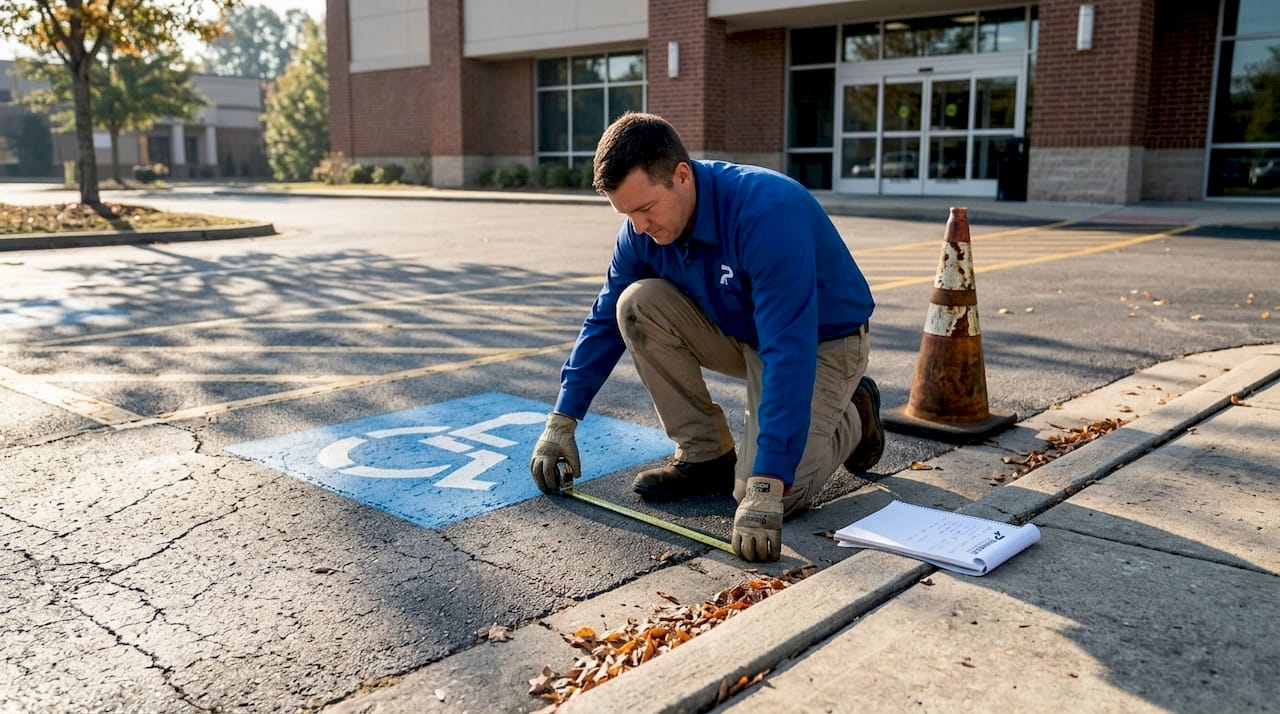
Van-accessible spaces have stricter requirements. Van-accessible spaces require 98 inches of vertical clearance for the parking space itself, the access aisle, and the entire vehicular route leading to and from the space. They must also be either 132 inches wide or 96 inches wide with an access aisle that is at least 96 inches wide.
Here is a side-by-side comparison:
| Feature | Car-accessible space | Van-accessible space |
|---|---|---|
| Minimum space width | 96 inches | 132 inches (or 96 with 96-inch aisle) |
| Minimum access aisle width | 60 inches | 96 inches |
| Vertical clearance required | Standard ceiling height | 98 inches minimum |
| Signage required | Yes, ISA symbol | Yes, ISA symbol + "Van Accessible" |
Common mistakes Tennessee property owners make during striping projects include:
- Striping access aisles that are too narrow because the crew eyeballed the width instead of measuring
- Placing accessible spaces in covered areas of a garage without verifying vertical clearance
- Forgetting the "Van Accessible" sign on the required number of spaces
- Painting the International Symbol of Access (ISA) without meeting the actual dimensional requirements
"Measuring once is not enough. Measure during layout, after striping, and again during a final walkthrough." This mindset separates a compliant lot from one that looks compliant on the surface but fails on inspection.
Pro Tip: Before any restriping project, walk every accessible space with a tape measure. A 6-inch shortfall in an access aisle is invisible to the eye but triggers a technical violation. See our discussion of van-accessible parking dimensions for a more detailed breakdown.
Location, routes, and real-world access
You can have the right number of spaces with perfect dimensions and still be non-compliant if those spaces are in the wrong location or connected to an inaccessible route. This is one of the most overlooked parts of the standard, and it causes real harm to people with disabilities who cannot reach the entrance safely.
The ADA is clear: accessible spaces must be placed on the shortest accessible route to an accessible facility entrance. When a parking lot serves multiple accessible entrances, accessible spaces must be dispersed and positioned closest to the entrances they serve. You cannot cluster all your accessible spaces at one end of a long building that has entrances at both ends.
The accessible route connecting those spaces to the entrance must meet its own set of standards. The accessible route must be at least 3 feet wide, have a firm, stable, and slip-resistant surface, avoid curbs and stairs, and have a slope along the route that does not exceed 1:12 (meaning 1 inch of rise for every 12 inches of horizontal distance).
Here is how to evaluate your routes correctly:
- Stand at each accessible space and walk the most direct path to the building entrance.
- Measure the route width at its narrowest point. It must clear 36 inches.
- Test the surface for loose gravel, cracked asphalt, or wet, slippery areas that could compromise stability.
- Look for curbs that cross the route without a proper curb cut. Any step is a barrier.
- Use a slope meter or level to verify grades. A route that feels flat can easily exceed 1:12.
Common real-world failings on Tennessee commercial properties include:
- Accessible spaces located at the far end of the lot, far from the main entrance
- A compliant space connected to a route that crosses a drainage curb with no cut
- Pavement that has heaved or cracked enough to create unstable footing along the route
- Seasonal debris, dumpster placement, or equipment storage blocking the accessible route
Understanding compliant surface markings is just as important as the physical layout. Review our ADA-compliant marking guide to see how thermoplastic markings hold up better than standard paint in high-traffic areas. When you are ready to act, our restriping service can handle layout planning and execution in one visit.
Resurfacing and restriping: Staying compliant during maintenance
Routine maintenance is not an excuse to delay compliance; it is actually the trigger that creates a legal obligation to address it. This surprises many property managers who assume they can restripe a lot the same way it was done before without worrying about the ADA.
When you restripe or resurface a parking lot, you are legally required to bring accessible spaces into full compliance with current ADA standards. When businesses restripe parking spaces, they must provide accessible spaces that meet the 2010 Standards, and existing facilities also carry a continuing obligation to remove barriers when doing so is "readily achievable." Restriping is frequently considered relatively inexpensive, which means it almost always qualifies as readily achievable under the law.
Here is how to handle a compliant restriping or resurfacing project:
- Do count all existing spaces before starting and recalculate your required accessible space count.
- Do verify that accessible spaces will be positioned correctly relative to entrances before laying any paint or thermoplastic.
- Do confirm vertical clearance in any covered or semi-covered area.
- Don't assume the old layout was compliant just because it was never challenged.
- Don't skip the van-accessible designation even if the previous striping omitted it.
- Don't rely on memory or photos of the old layout. Measure everything fresh.
Pro Tip: A resurfacing or sealcoating project is the single best time to correct existing ADA deficiencies because the entire lot surface is already being worked. Bundling compliance upgrades with routine maintenance keeps costs low and ensures no shortcuts are taken. Check out our breakdown of sealcoat vs. resurfacing options to understand which treatment is right for your lot and when.
Expert perspective: Why ADA parking compliance is a measurement-driven process
We have seen hundreds of Tennessee parking lots over the years, and here is the honest truth: most violations are not caused by property owners who ignored the ADA. They are caused by property owners who thought they were compliant because they had signs and symbols painted on the ground.
Conventional wisdom says "put up the blue sign and the wheelchair symbol." That advice is incomplete and, in many cases, legally dangerous. The overwhelming majority of ADA citations and lawsuits we are aware of involve measurable, physical layout failures. An aisle that is 54 inches wide instead of 60. A van-accessible space without the vertical clearance. A route that looks fine but slopes at 1:9 instead of 1:12. These are not judgment calls. They are measurements.
The shift in mindset we encourage every property owner to make is simple: treat ADA compliance like a physical audit, not a visual check. Walk your lot with a tape measure and a printed checklist. Verify every dimension. Check every route. Confirm every sign matches the space designation behind it. Real compliance examples show how quickly a lot that looks compliant on camera can fail a physical inspection.
The properties that consistently pass compliance checks and avoid complaints are the ones where someone walked that lot with eyes on the ground, not just a drone shot from above. Measurements protect you. Assumptions do not.
Need help ensuring ADA-compliant parking lots?
ADA compliance in a parking lot is not a one-time project. Pavement shifts, lines fade, and regulations require attention every time you resurface or restripe. Getting it right means working with a contractor who understands the exact measurements, space counts, and layout rules, not just someone who can operate a striping machine.

At Pinnacle Pavement Solutions, we bring professional-grade equipment, detailed measurements, and a thorough understanding of ADA standards to every parking lot striping project we take on in Tennessee. We document every job with drone footage so you have a visual record of your compliant layout. Whether you need a full restripe, new ADA space layouts, thermoplastic handicap markings, or a full pavement overhaul, our team handles it from measurement to final inspection. Explore our asphalt services to see how we combine surface work and compliant striping into one seamless project for commercial properties across Tennessee.
Frequently asked questions
How do I calculate the number of ADA parking spaces required for my lot in Tennessee?
Use the ADA table, which bases the required number of accessible spaces on each individual lot's total space count. For example, a lot with 26 to 50 spaces requires two accessible spaces, calculated per facility, not across your entire site.
What features make a parking space van-accessible?
A van-accessible space must have 98 inches of vertical clearance for the space, access aisle, and vehicular route, and must be either 132 inches wide or 96 inches wide with a 96-inch-wide access aisle, plus a sign reading "Van Accessible."
Is restriping or resurfacing an ideal time to address ADA compliance?
Yes. ADA law requires that businesses providing accessible spaces meet the 2010 Standards when restriping, and existing facilities must remove barriers when it is readily achievable. Restriping typically qualifies as inexpensive enough to meet that threshold.
What is an "accessible route," and how is it different from a standard walkway?
An accessible route must be at least 3 feet wide, with a firm, stable, slip-resistant surface, no curbs or stairs crossing the path, and a slope no greater than 1:12. A standard walkway has no legal requirements for width, surface, or grade.