
Residential asphalt driveway care is one of the most overlooked home maintenance tasks, yet it has a bigger payoff than most homeowners expect. A well-maintained asphalt driveway can last 25 to 30 years. Ignore it, and you're looking at 10 to 15 years before you need a costly replacement. The good news? The steps that make the biggest difference are straightforward, affordable, and take just a few hours a year. This guide walks you through everything: inspections, crack repair, sealcoating, drainage, and how to know when to call in a professional.
Table of Contents
- Key takeaways
- Residential asphalt driveway care starts with inspections
- Crack filling: the highest-ROI maintenance task
- Sealcoating: protection, aesthetics, and timing
- Drainage and pothole repair
- Long-term strategy: schedules, costs, and replacement
- My honest take on driveway maintenance mistakes
- Let Pinnaclepave handle the hard part
- FAQ
Key takeaways
| Point | Details |
|---|---|
| Inspections twice a year | Check your driveway every spring and fall to catch damage before it spreads. |
| Crack filling is highest ROI | Sealing cracks early can add up to 7.5 years to your driveway's life. |
| Sealcoat every 3 to 5 years | Regular sealcoating blocks UV, water, and oil damage that gradually destroys the surface. |
| Water is the real enemy | Poor drainage can cut your asphalt's lifespan in half if left unaddressed. |
| Maintenance saves thousands | Annual upkeep costs $50 to $300 DIY versus thousands for premature replacement. |
Residential asphalt driveway care starts with inspections
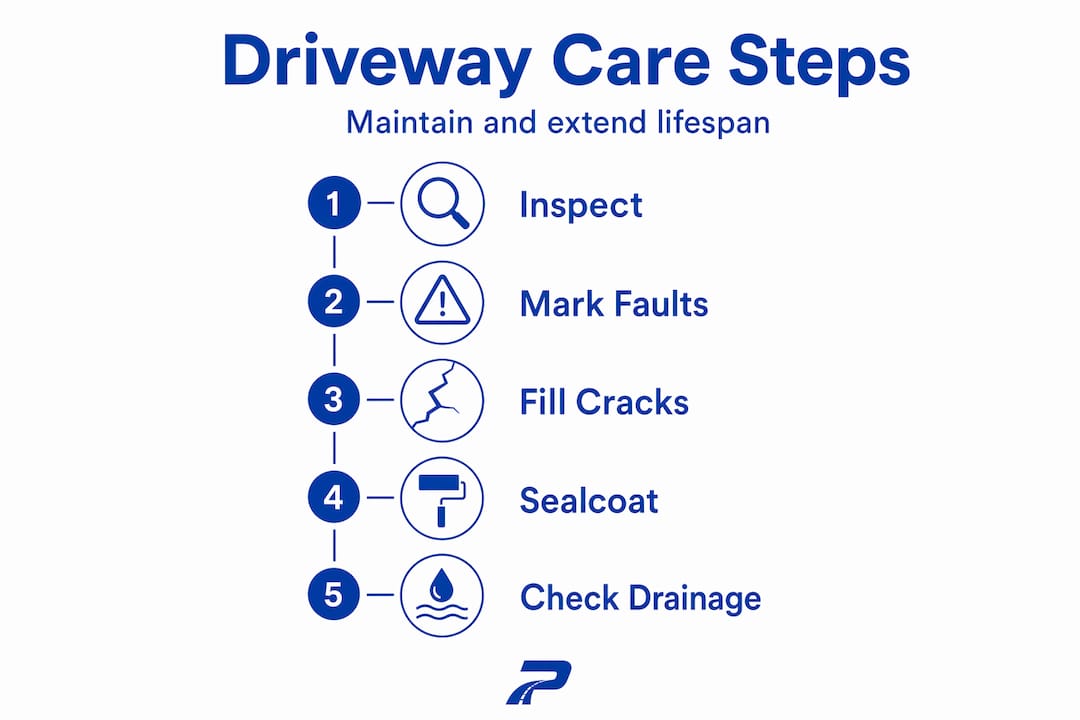
Most homeowners only look at their driveway when something is obviously wrong. By then, a small crack has already let water into the base, and what was a $20 fix is now a $200 problem. Inspecting twice a year, once in spring and once in fall, gives you a clear picture of what winter freeze-thaw cycles or summer heat has done to the surface.
Spring is when you will find the most damage. Freeze-thaw cycles push water into tiny cracks, that water expands as ice, and the crack widens. Fall inspection is your last chance to address anything before winter makes it worse.
Here is what to look for during each walkthrough:
- Cracks wider than 1/8 inch. Narrow hairline cracks are surface-level. Anything wider is an entry point for water.
- Alligator cracking. That interconnected, scaly pattern means the base underneath is compromised. This is not a DIY fix.
- Edge crumbling. The edges of a driveway take the most stress from vehicles pulling partially off the surface. Missing edge support leads to rapid spread.
- Water ponding. Any spot where water pools after rain signals a drainage problem that will accelerate deterioration.
- Potholes. Even small depressions deserve attention before vehicle traffic makes them larger.
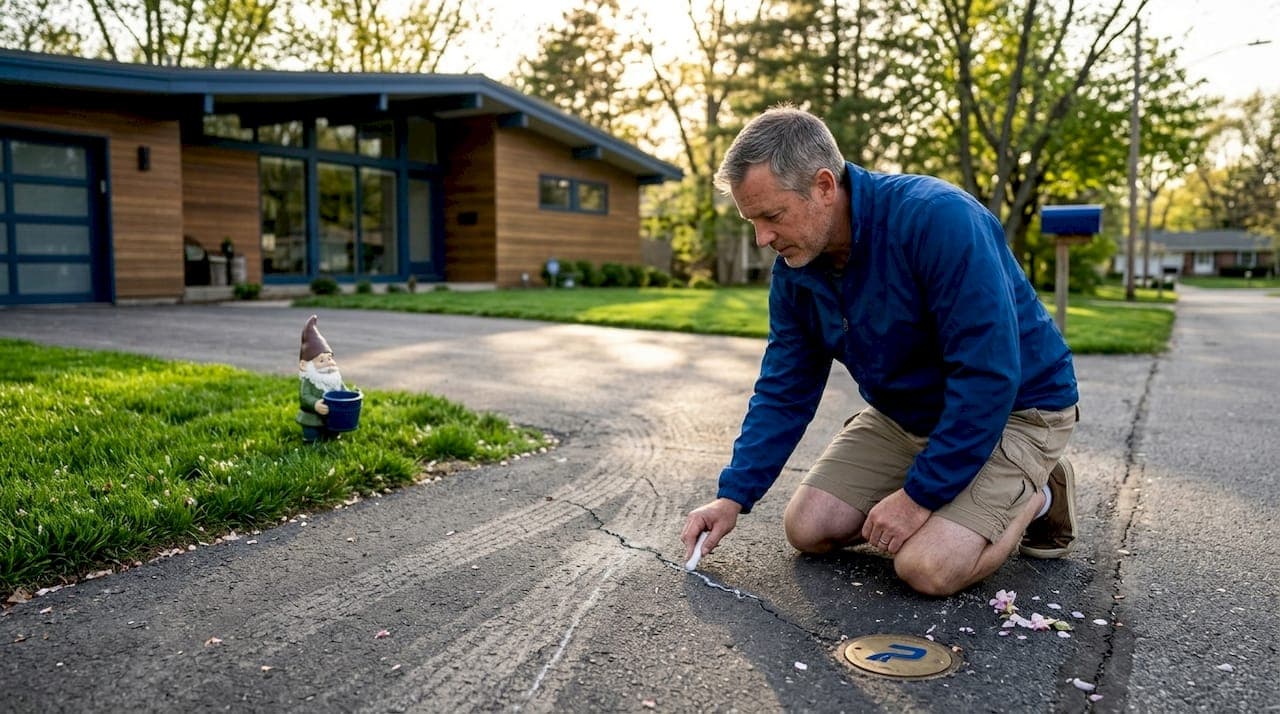
Pro Tip: Carry a piece of chalk or a roll of painter's tape during your inspection. Mark every crack or problem spot immediately so nothing gets forgotten before you schedule repairs.
Walk the full length of the driveway and crouch down to check for low spots that might not be obvious when standing upright. Take photos with your phone and date them. Comparing photos from one inspection to the next is the fastest way to know if a crack is growing.
Crack filling: the highest-ROI maintenance task
No single maintenance step does more for asphalt driveway longevity than filling cracks early. Crack sealing extends pavement life by up to 7.5 years and reduces new crack formation by roughly 50%. That is a remarkable return on what might be a $20 tube of crack filler.
Here is why cracks are so destructive if you leave them alone. Water gets in, soaks the base material, softens it, and the surface above loses its support. In colder climates, that water freezes, expands, and physically breaks the asphalt apart. Freeze-thaw cycles cause cracks to widen rapidly, and debris packing into the crack makes it even harder for the edges to stay together.
Follow these steps to seal cracks correctly:
- Clean the crack thoroughly. Use a wire brush, a garden hose, or a leaf blower to remove all loose debris, vegetation, and dirt. Sealant will not bond to a dirty surface.
- Let it dry completely. Moisture trapped under sealant causes it to fail within a season. Give the crack at least 24 hours after washing.
- Check the temperature. Apply crack filler when surface temperatures are above 50°F. Cold asphalt is less pliable and adhesion suffers below that threshold.
- Apply the filler. Use a pourable crack filler for cracks wider than 1/4 inch and a liquid crack sealer for smaller ones. Fill slightly overfull, then smooth flush with a putty knife or squeegee.
- Allow full cure time. Most products need 24 to 48 hours before vehicle traffic. Do not rush this.
Professional crack sealing goes a step further. Proper crack sealing involves routing the crack to create a uniform reservoir, then applying hot-pour sealant with a detack agent to prevent tire sticking. For large networks of cracks or areas near the edge of the driveway, professional work pays for itself quickly.
Pro Tip: Never sealcoat over unfilled cracks. The sealcoat will bridge the crack temporarily but will crack again in the same spot within one season, leaving you with a surface that looks worse than before.
Sealcoating: protection, aesthetics, and timing
Sealcoating is the task most homeowners have heard of, but many either skip it entirely or apply it too often. Both mistakes cost you. Sealcoating protects asphalt from UV rays, water penetration, and oil spills, and the recommended frequency is every 3 to 5 years.
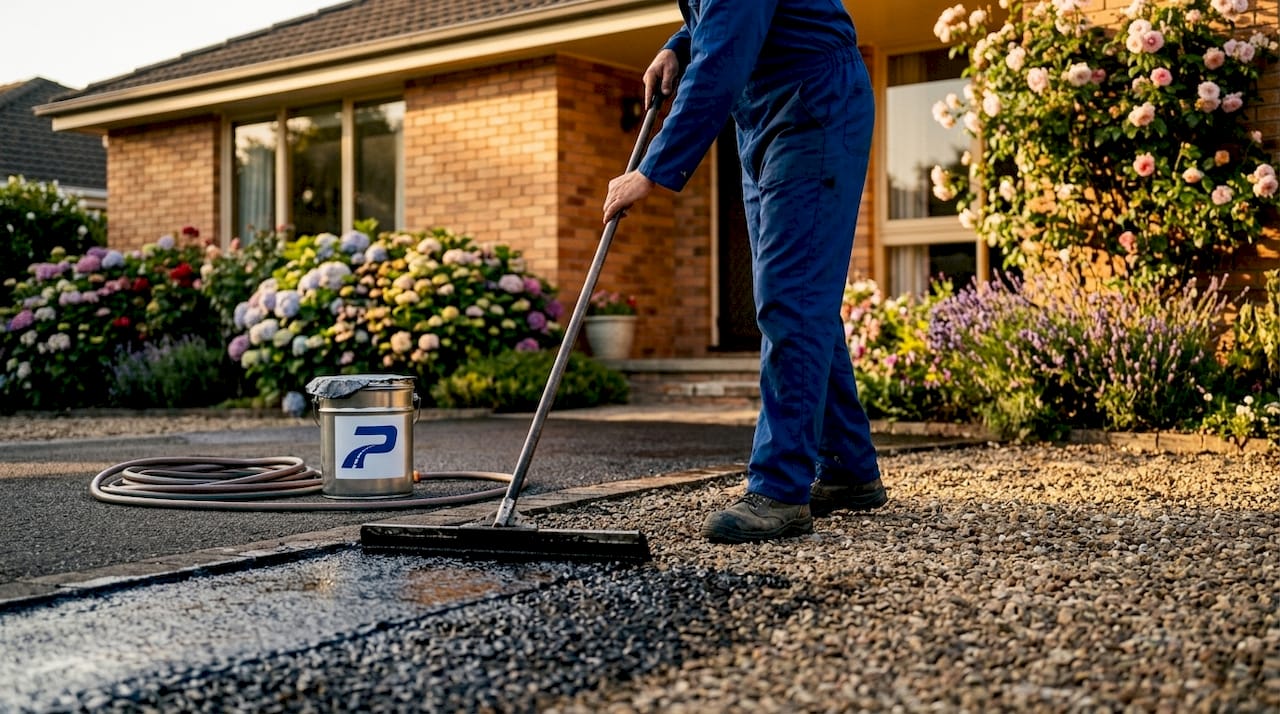
Signs that your driveway needs sealcoating include a faded gray color instead of deep black, small surface cracks forming across a broad area, and water that no longer beads on the surface. When water soaks in instead of running off, the asphalt is exposed.
DIY vs. professional sealcoating
| Factor | DIY sealcoating | Professional sealcoating |
|---|---|---|
| Cost | $50 to $150 for materials | $200 to $500 for an average driveway |
| Drying time | 24 to 48 hours (keep off) | 24 to 48 hours (keep off) |
| Equipment needed | Squeegee or brush, tape for edging | Professional spray equipment |
| Typical lifespan | 2 to 3 years per coat | 3 to 5 years per coat |
| Best for | Small driveways, budget-conscious owners | Large driveways, best finish quality |
Never sealcoat a brand-new driveway. New asphalt needs at least 90 days to cure before its oils have off-gassed enough for sealant to adhere properly. Sealing too early traps oils and causes peeling. Also, avoid applying more than two coats total over the life of your driveway before stripping the old buildup. Too many layers eventually crack on their own. For a deeper breakdown of material options, the sealcoating materials guide from Pinnaclepave covers the differences in product types and what works best in specific climates.
Pro Tip: Check the five-day weather forecast before scheduling sealcoating. You need at least two dry days above 50°F after application. Rain on fresh sealcoat ruins the cure and forces you to start over.
Drainage and pothole repair
Standing water is the greatest enemy of asphalt, and poor drainage can cut a driveway's lifespan in half. This is not a subtle threat. Water that sits on asphalt softens the surface, works its way into the base, and creates the exact conditions that turn a hairline crack into a pothole.
Watch for these drainage warning signs:
- Puddles that remain hours after rain ends
- Erosion along the driveway edges where soil has washed away
- Cracks that appear in a curved or low-lying section of the driveway
- Catch basins or gutters near the driveway that are clogged with leaves
Simple fixes handle most drainage problems before they escalate. Clearing debris from nearby gutters and downspouts, adding gravel edging to prevent soil washout, and having a contractor adjust the driveway grade slightly can all make a significant difference. A driveway should slope at least 1 to 2 percent away from your home and garage.
Pothole stages and repair costs
| Pothole stage | Description | Repair approach | Estimated cost |
|---|---|---|---|
| Stage 1: small depression | Surface soft spot under 6 inches | Cold patch DIY | $15 to $25 |
| Stage 2: open hole | Base exposed, edges loose | Cold patch or hot mix | $50 to $150 DIY |
| Stage 3: structural failure | Base eroded, wide spread cracking | Professional full-depth repair | $200 to $800+ |
Small potholes cost $15 to $25 to fix yourself with cold patch material available at any home improvement store. Compact the patch in layers of no more than 2 inches each for best adhesion. Once a pothole reaches stage 3, no amount of cold patch will hold. The base itself needs professional attention.
Long-term strategy: schedules, costs, and replacement
The most cost-effective approach to asphalt driveway longevity is a predictable maintenance schedule. Annual routine maintenance, including spring and fall inspections, prompt crack filling, sealcoating every 3 to 5 years, and pothole repair, can push a driveway's lifespan to 25 to 30 years instead of 10 to 15.
Here is how that breaks down financially. DIY maintenance averages $50 to $300 per year, while professional service averages $200 to $800 annually. Over a decade, that adds up to $1,200 to $4,800 in maintenance. A full driveway replacement runs $3,600 to $8,400 and often more for larger driveways. Maintenance is not an expense. It is a savings strategy.
When your driveway reaches its mid-life stage, typically around 10 to 15 years old, you face a decision between an overlay and a full replacement. An overlay is suitable when the base is still structurally sound. If you are seeing widespread alligator cracking, base failure, or drainage problems, an overlay is just a cosmetic fix on a broken foundation. Replacement is the only path forward. For a side-by-side comparison of both options, Pinnaclepave's guide on sealcoat vs. resurfacing is worth reading before you commit to either.
Consider these factors when planning your long-term maintenance approach:
- Climate. Homeowners in freeze-thaw climates like Tennessee need to prioritize crack filling every fall before temperatures drop.
- Vehicle loads. Heavy trucks or trailers parked regularly accelerate rutting and edge crumbling. Reinforced edge restraints help.
- Driveway age. A 5-year-old driveway needs different care than a 20-year-old one. Adjust your asphalt maintenance frequency accordingly.
- Base condition. Proper base compaction and edge support are the foundation of everything. No surface repair fixes a failed base.
My honest take on driveway maintenance mistakes
I have seen hundreds of driveways at every stage, and the pattern is almost always the same. Homeowners notice a crack, figure it is not that bad yet, and wait. A year later, that crack has invited water into the base, winter has done its damage, and now there is a pothole where a $20 fix used to be.
The biggest mistake is treating crack repair as optional. It is not optional. It is the single step that does more for asphalt surface life expectancy than anything else you can do. Sealcoating gets all the attention because it makes a driveway look brand new. But sealcoat over unfilled cracks and you have just paid for a short-term cosmetic result.
The second biggest mistake is skipping inspections. You do not need a contractor to walk your own driveway twice a year. Get low, look down the length of it in both directions, check after a heavy rain, and photograph anything that concerns you. That habit alone puts you ahead of most homeowners.
My practical advice: do the inspections and crack filling yourself. They are simple and genuinely effective. But for sealcoating a large driveway or for any repair involving the base layer, call a professional. DIY sealcoating on a long, sloped, or heavily cracked driveway is where most people create more problems than they solve. Knowing which tasks to own and which to hand off is the smartest part of any maintenance plan.
— Dillan
Let Pinnaclepave handle the hard part
If your driveway needs more than a DIY touch-up, Pinnaclepave brings professional-grade equipment and real experience to every job. From sealcoating and crack filling to full asphalt repair and maintenance, the team handles residential driveways throughout Tennessee with honest pricing and documented results.

Whether you are dealing with a network of cracks you have been putting off, a pothole that keeps coming back, or a driveway that is due for its first sealcoat in years, Pinnaclepave has the tools and the knowledge to get it done right. Visit Pinnacle Pavement Solutions to request a free estimate, or check out the professional sealcoating services page to see what a quality application looks like before you decide. Your driveway is a long-term investment. Protect it with professionals who treat it that way.
FAQ
How often should I seal my asphalt driveway?
Sealcoat your driveway every 3 to 5 years for effective protection. Signs you are overdue include a gray surface color, small surface cracks, and water that soaks in rather than beading up.
What is the best time of year to fill asphalt cracks?
Fill cracks in late spring or early fall when surface temperatures are consistently above 50°F. Sealing before winter prevents freeze-thaw damage from widening cracks into potholes.
Can I fix a pothole myself?
Yes, for small potholes under 12 inches wide and without base failure, cold patch material works well. Compact the patch in 2-inch layers. Larger or recurring potholes usually signal a base issue that requires professional repair.
How long does a well-maintained asphalt driveway last?
With consistent maintenance, including biannual inspections, crack filling, and sealcoating every 3 to 5 years, an asphalt driveway can last 25 to 30 years compared to 10 to 15 years without care.
When should I choose an overlay instead of replacing my driveway?
Choose an overlay when the base layer is still structurally sound and damage is limited to the surface. If you see widespread alligator cracking, drainage failures, or deep base erosion, a full replacement is the only fix that will last.