

Walk any commercial parking lot in Tennessee and you're standing on a decision someone made years ago. That decision either saved the property owner money over time or cost them twice what they planned to spend. Most property owners treat asphalt like a commodity, assuming the only real difference between bids is price. That thinking leads to cracked surfaces, premature failures, and expensive fixes that could have been avoided entirely. The truth is, asphalt mix selection shapes every outcome you care about: durability, appearance, maintenance costs, and the long-term value of your investment.
Table of Contents
- What is an asphalt mix and why does it matter?
- Types of asphalt mixes used in Tennessee
- How to choose the right asphalt mix for your property
- Maximizing longevity: Care and maintenance essentials
- Why most owners overlook asphalt mix choice and what it really costs you
- Ready to improve your asphalt surface?
- Frequently asked questions
Key Takeaways
| Point | Details |
|---|---|
| Mix selection matters | Choosing the right asphalt mix affects durability, cost, and curb appeal. |
| Tailor for Tennessee | Local climate and property use are vital factors in asphalt mix choice. |
| Add maintenance strategy | Ongoing sealcoating and repairs maximize the value of your chosen mix. |
| Consult experts | Professional input helps you match the optimal mix and care plan to your property. |
What is an asphalt mix and why does it matter?
An asphalt mix is not simply "black pavement poured on the ground." It is a precisely engineered combination of three core elements: a binder (typically asphalt cement, which holds everything together), aggregate (crushed stone, gravel, and sand that form the structural body), and additives (polymers, fibers, or rejuvenators that fine-tune performance for specific conditions). Change the ratio of any one component, and you change the way the finished surface handles heat, cold, weight, and water.
The binder percentage directly affects flexibility. Too little binder and the surface becomes brittle and cracks under freeze-thaw stress. Too much and it becomes soft under heavy traffic, causing rutting. The aggregate gradation (meaning the size distribution of stones in the mix) determines surface texture, drainage, and load-bearing capacity. Coarser aggregate handles heavy truck traffic well. Finer aggregate creates a smoother, quieter surface better suited to residential driveways and retail lots.
Here is where most owners get tripped up. Asphalt mix terminology can seem technical, but clear definitions of mix elements support effective decisions, and understanding even the basics puts you ahead of most property owners making expensive paving choices.
Common misconceptions include:
- All black asphalt looks and performs the same regardless of what went into it
- Cheaper mixes only look a little worse, not structurally different
- Mix type does not affect how often you need to seal or repair your pavement
- The contractor knows best so there is no need to ask about the mix specification
- Tennessee weather is mild enough that any standard mix will hold up fine
None of those assumptions are accurate, and every one of them costs money.
Pro Tip: Before signing any paving contract, ask the contractor to specify the mix design in writing, including binder grade and aggregate size. A reputable contractor will provide this without hesitation.
Types of asphalt mixes used in Tennessee
Tennessee sits in a climate zone that throws real challenges at pavement. Summers regularly push into the 90s with high humidity. Winters bring freeze-thaw cycles, especially in Middle and East Tennessee, where temperatures swing dramatically in a single week. Add heavy spring rains and the occasional ice event, and your pavement needs to perform across a wide range of conditions. Pavement standards in Tennessee reflect these realities, and selecting a mix that matches local climate and traffic is crucial for performance.
The three most common mix categories you will encounter are:
- Hot mix asphalt (HMA): Produced and placed at high temperatures (typically 275 to 325 degrees Fahrenheit), HMA is the industry standard for most commercial and residential applications. It bonds tightly, compacts well, and delivers excellent durability across Tennessee's seasonal extremes.
- Warm mix asphalt (WMA): Made at lower temperatures using chemical additives or foaming processes. WMA reduces energy consumption during production and allows longer haul times, which is valuable for large projects where material needs to travel farther from the plant. Performance rivals HMA when properly specified.
- Cold mix asphalt: Pre-mixed and placed at ambient temperatures. Primarily used for pothole patching and temporary repairs. Not suitable as a primary surface for driveways, parking lots, or any surface under sustained traffic.
| Mix type | Ideal use | Tennessee suitability | Durability | Maintenance needs |
|---|---|---|---|---|
| Hot mix asphalt (HMA) | Driveways, parking lots, roads | Excellent | High (15 to 25+ years with care) | Regular sealcoating, occasional crack fill |
| Warm mix asphalt (WMA) | Large commercial projects, eco-sensitive zones | Very good | High (comparable to HMA) | Similar to HMA |
| Cold mix asphalt | Potholes, temp patches | Limited (repair only) | Low | Frequent; not a permanent fix |
Beyond these broad categories, mix designs are further classified by aggregate gradation into dense-graded (the most common, good for general use), open-graded (porous, promotes drainage), and stone matrix asphalt or SMA (high stone content, premium durability for heavy-traffic areas). A well-designed HMA with the right binder grade for Tennessee's temperature range can last 20 to 25 years with proper maintenance, while a poorly specified basic mix may need significant intervention within 8 to 10 years.
Property types matched to ideal mixes:
- Residential driveways: Fine-graded dense HMA for smooth appearance and good load tolerance
- Commercial parking lots: Medium-graded HMA or SMA for high vehicle turnover and UV resistance
- Warehouse and distribution facility drives: Coarse HMA or SMA to handle heavy trucks and forklifts at entry points
- Municipal paths and low-traffic roads: WMA or standard HMA depending on project size and budget
- High-drainage areas near retention ponds: Open-graded mixes to reduce standing water
Explore the full range of types of asphalt services available for Tennessee properties to see how these mix types apply to specific project scenarios.
How to choose the right asphalt mix for your property
Choosing the right mix is a decision process, not a one-size-fits-all answer. Property owners who skip this process and simply accept whatever the lowest bid includes often find themselves paying for repairs within a few years. Considering both surface use and local standards leads to better, longer-lasting surfaces, and the steps below give you a practical framework for making that call confidently.
Step 1: Define the surface use. Will this pavement carry passenger vehicles only, or do you expect delivery trucks, forklifts, or dumpster loads? Heavy equipment demands coarser aggregate and a stiffer binder.
Step 2: Assess traffic volume and patterns. A parking lot that sees 50 cars a day needs a different spec than a distribution center entrance used by 18-wheelers around the clock. High traffic volumes accelerate rutting if the binder grade is too soft.

Step 3: Evaluate your local climate exposure. Properties in East Tennessee face more freeze-thaw cycles than those in Memphis. A binder grade like PG 76-22 performs well in high-heat areas, while PG 64-22 works better where cold cracking is the bigger risk.
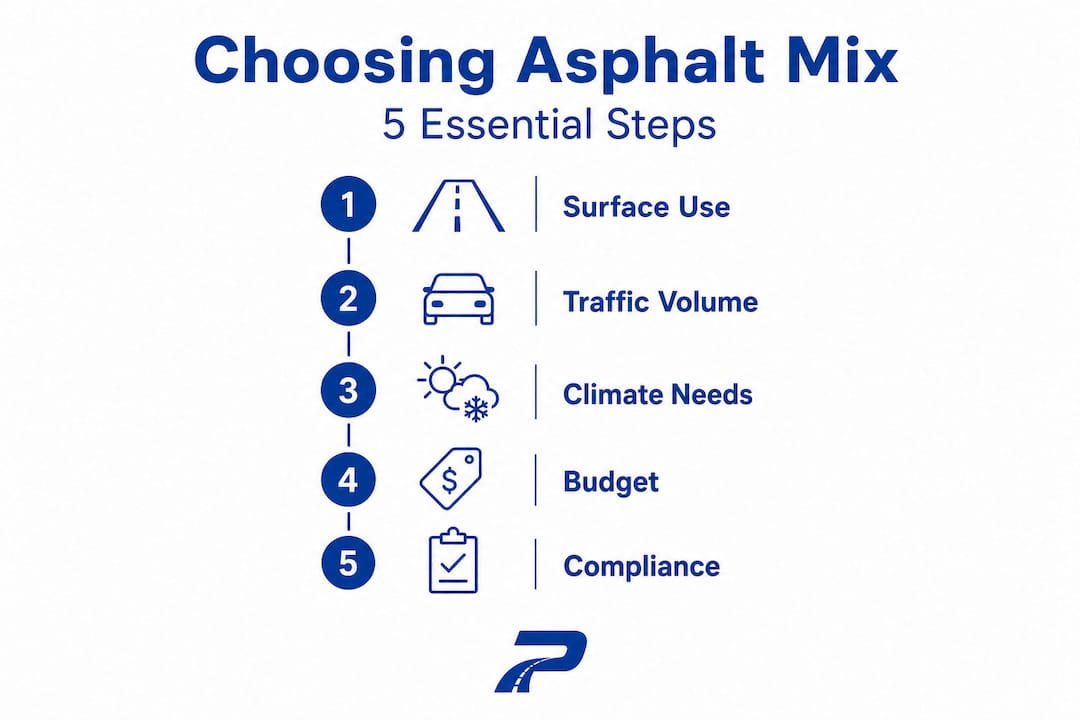
Step 4: Set a realistic budget with lifecycle thinking. The cheapest upfront option is rarely the most affordable over 20 years. Calculate total cost of ownership, not just installation day.
Step 5: Factor in compliance and ADA requirements. Parking lots require ADA-compliant slopes, marked spaces, and surfaces that hold striping well. Some mix surfaces accept paint and thermoplastic markings better than others.
| Property type | Key factor | Recommended mix focus | Long-term cost risk |
|---|---|---|---|
| Retail parking lot | High UV, heavy foot traffic | Dense HMA, polymer-modified | Moderate without sealcoating |
| Industrial facility | Heavy truck loads | SMA or coarse HMA | Low with correct spec |
| Residential driveway | Aesthetics, light loads | Fine HMA | Low overall |
| Municipal road | Durability, public safety | HMA per TDOT spec | Moderate |
When weighing your options, review a solid sealcoat vs. resurfacing guide to understand whether your existing pavement needs a new mix layer or just a protective coating.
Pro Tip: Get at least three quotes and ask each contractor to explain their proposed mix design, not just the price. A low bid often hides a lower-grade mix that will cost you more in maintenance within three to five years.
Maximizing longevity: Care and maintenance essentials
Choosing the right mix is step one. Protecting that investment through smart maintenance is what separates pavement that looks good for two decades from pavement that starts failing in year six. The care strategy has to match the mix you installed and the demands of your property.
Routine maintenance essentials for Tennessee properties include:
- Sealcoating: Applied every two to four years depending on sun exposure and traffic, sealcoating fills surface voids, blocks UV oxidation, and prevents water intrusion. It also refreshes the appearance, which matters for retail and commercial curb appeal.
- Crack sealing: Addressed immediately when cracks appear. Tennessee's temperature swings cause cracks to expand and contract, pushing water deeper into the base. Water in the base is the beginning of the end for any pavement surface.
- Routine inspection: Walk your lot or driveway seasonally, especially after winter. Catch edge deterioration, drainage issues, and soft spots early.
- Line striping maintenance: Faded striping is a liability issue and a compliance risk. Fresh lines reflect a well-managed property and keep traffic flowing safely.
"The biggest single mistake we see from property owners is waiting until the surface looks damaged before calling us. By that point, the repair cost is three to five times what a proactive sealcoating schedule would have cost over the same period."
The benefits of sealcoating are well documented: sealcoating and routine maintenance extend pavement life regardless of mix type, adding years of functional service at a fraction of replacement cost.
Common mistakes that shorten pavement lifespan:
- Skipping the first sealcoat because the surface still looks new (oxidation begins immediately after installation)
- Using petroleum-based chemicals near the surface, which dissolves the binder
- Ignoring ponding water that indicates drainage failure
- Allowing tree roots near pavement edges to go unmanaged
- Pressure washing with too high a setting, which strips the surface texture
Why most owners overlook asphalt mix choice and what it really costs you
Here is an observation built from years of working with property owners across Tennessee: almost everyone focuses on two things when getting a paving quote. The final number and the finish color. That focus is understandable but it misses the variable that actually determines whether they are happy two years later or calling for emergency repairs.
The hidden cost of a wrong mix decision is not visible on installation day. A property that goes with the lowest bid on a basic mix will look identical to a property that paid a modest premium for a properly specified mix in month one. The divergence happens around year three to five, when the cheaper surface starts showing UV damage, micro-cracking, and soft spots near drainage areas. By year eight, the low-bid property often needs partial milling and overlay, a cost that frequently exceeds the original price difference multiplied by three.
We have seen this pattern repeatedly. A property manager chooses the premium mix for a 40,000 square foot commercial lot and commits to a sealcoating schedule. Fifteen years later the surface still looks sharp, striping holds, and ADA markings are clear. A comparable property nearby goes cheap on the mix and skips sealcoating to save money. At the ten-year mark, they are looking at full replacement. The lifetime cost gap is enormous.
Understanding mix terminology is not just academic. It gives you the language to have an informed conversation with any contractor, which means you can push back on under-specified bids and ask the right questions before you sign.
The insider advice here is simple but often ignored: never make a paving decision on a single quote, and never let price be the only filter. Local expertise, climate-appropriate specs, and a contractor who will put the mix design in writing are worth every dollar of the premium they charge.
Ready to improve your asphalt surface?
Knowing the difference between mix types and understanding how to match a surface to your property's demands gives you a significant advantage as a property owner or manager in Tennessee. Putting that knowledge into action is where Pinnacle Pavement Solutions comes in.
Pinnacle handles every stage of your pavement project under one roof: mix selection and consultation, full-depth asphalt paving services, and professional sealcoating experts who keep your surface protected long after the initial pour. Whether you manage a commercial parking lot, a warehouse facility, or a residential property, our team brings honest pricing and drone-documented results to every job. Contact the Tennessee pavement experts at Pinnacle today to schedule your consultation and get a mix recommendation built around your property, not a generic template.
Frequently asked questions
What is the best asphalt mix for Tennessee driveways?
Hot mix asphalt is typically recommended because it withstands local temperature swings and traffic demands across Tennessee's varied seasonal conditions.
Does asphalt mix type affect maintenance frequency?
Yes, higher-quality or custom mixes usually need less frequent repairs. Sealcoating and routine maintenance extend pavement life regardless of mix type, but a well-specified mix stretches the intervals between major interventions.
Can I resurface old asphalt with a new mix?
In many cases, resurfacing with a new asphalt mix is possible and cost-effective if the base is structurally sound. A sealcoat vs. resurfacing comparison helps you determine which approach fits your existing pavement's condition.
How does routine sealcoating help my asphalt surface?
Sealcoating protects asphalt from weather and extends its service life by reducing oxidation and water damage. The top benefits of sealcoating include improved appearance, slower deterioration, and better long-term cost control.