
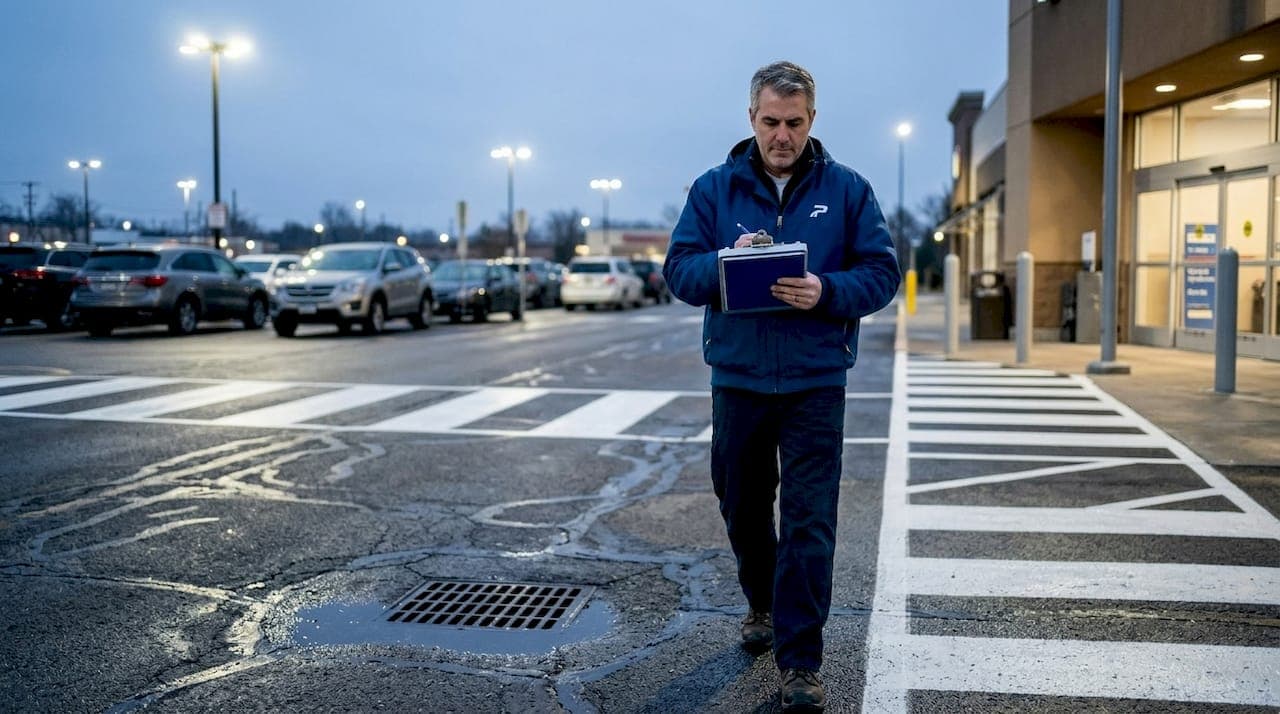
Parking lots are among the highest-risk areas on any commercial property, yet they rarely get the safety attention they deserve until something goes wrong. Slip-and-fall injuries, pedestrian conflicts, vehicle collisions, and opportunistic crimes happen daily in lots across the country. As a property manager, business owner, or safety officer, you carry real legal and moral accountability for what happens on that pavement. These parking lot safety tips cut through the generic advice and give you a practical, compliance-minded framework you can act on right now.
Table of Contents
- Key Takeaways
- 1. Audit your parking lot lighting from the ground up
- 2. Maintain pavement surfaces and markings to prevent trips and confusion
- 3. Control driver behavior with physical design, not just signs
- 4. Communicate personal safety protocols to employees and visitors
- 5. Build a seasonal maintenance plan for year-round safety
- 6. Create a standing parking lot safety checklist
- My take on what actually moves the needle
- How Pinnaclepave can support your safety upgrades
- FAQ
Key Takeaways
| Point | Details |
|---|---|
| Lighting is your first line of defense | Poor lighting drives both accident and crime rates. Upgrade to uniform LED coverage and eliminate shadow zones. |
| Pavement condition and markings prevent injuries | Clear striping, pothole-free surfaces, and ADA-compliant routes reduce slips, trips, and traffic confusion. |
| Speed and driver behavior require physical controls | Signs alone won't slow drivers. Speed bumps and visible design changes are proven deterrents. |
| Seasonal maintenance is a compliance requirement | OSHA mandates snow and ice removal from pedestrian walking surfaces. Don't treat it as optional. |
| Personal safety protocols need active communication | Post guidelines, train staff, and make sure visitors know how to navigate the lot safely. |
1. Audit your parking lot lighting from the ground up
Lighting is the single highest-leverage improvement most parking lots can make. About 74% of pedestrian fatalities occur in dark conditions. That number should reset how you think about your lighting budget.
The goal isn't just "having lights." It's uniform coverage with no dead zones. Here's what a solid lighting audit should flag:
- Shadow zones near entry points, stairwells, and dumpster areas where crime risk concentrates
- Burned-out or flickering fixtures that create unpredictable visibility
- Poorly aimed fixtures that light the sky instead of the ground
- Gaps between light poles that leave stretches of pavement in darkness
LED lighting is the current standard for commercial lots. It offers longer life, lower energy costs, and better color rendering than older sodium vapor fixtures. Motion-sensor lights work well in low-traffic sections like secondary rows or back corners, but they should supplement always-on lighting rather than replace it.
Pair good lighting with visible pavement markings and directional signage, both of which become dramatically easier to follow when pedestrians can actually see them. Security cameras add another layer, and their effectiveness multiplies when the area is already well lit.
Pro Tip: Walk your lot at night, ideally without warning your maintenance staff. What you see as a visitor after dark is what your actual risk exposure looks like.
2. Maintain pavement surfaces and markings to prevent trips and confusion
The physical condition of your pavement is not a cosmetic issue. Potholes, surface cracks, uneven transitions, and faded striping all translate directly into slip-and-fall liability and traffic flow problems.
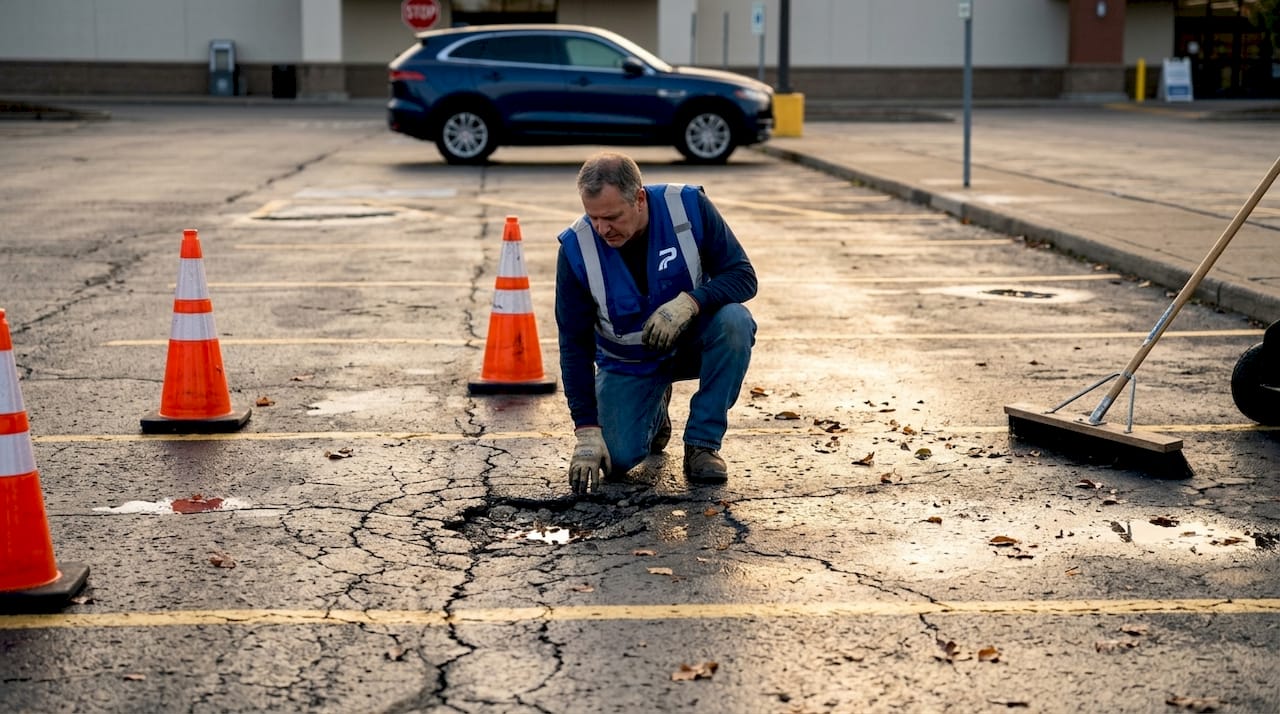
Here's a quick comparison of common pavement marking materials to help you decide what fits your situation:
| Marking Type | Durability | Best Use Case | ADA Suitable |
|---|---|---|---|
| Standard paint | 1 to 2 years | Budget restriping, low-traffic lots | Yes, short term |
| Thermoplastic | 5 to 7 years | High-traffic commercial lots | Yes, long term |
| Epoxy-based marking | 3 to 5 years | Indoor garages, smooth surfaces | Yes |
| Reflective thermoplastic | 5 to 7 years | Night visibility, drive lanes | Yes |
ADA compliance deserves specific attention. Accessible parking routes must follow the shortest accessible path, with surface slopes not exceeding 1:12, route widths of at least 3 feet, and curb-free transitions. That's not just a legal checkbox. A non-compliant accessible route is a documented trip hazard.
You can explore the full breakdown of Tennessee-specific requirements in this ADA parking compliance guide if your property operates in the region.
Beyond ADA, your striping layout controls traffic flow. Faded lines lead to improvised parking, blocked fire lanes, and pedestrian path confusion. Restriping is one of the highest-value, lowest-cost safety investments a property manager can make.
Pro Tip: ADA compliance doesn't end at the parking stall. The accessible route from the stall to the building entrance must meet the same slope and surface standards. That connecting path is where most violations hide.
3. Control driver behavior with physical design, not just signs
Signs matter. But if a sign is the only thing slowing drivers down in your lot, you have a gap. A three-vehicle crash in a Pennsylvania parking lot caused by excessive speed led to vehicle damage, minor injuries, and a careless driving citation. The incident prompted a police safety warning specifically targeting parking lot driver behavior.
The lesson isn't that drivers are reckless. It's that parking lots don't feel like traffic zones to most people. Speed and design interventions change that perception physically, not just visually.
Practical measures that work:
- Speed bumps or speed humps at lot entry points and near pedestrian crossings
- Designated pedestrian lanes with painted crosswalks and clear priority signage
- One-way traffic flow using arrows and lane markings to eliminate head-on conflicts
- Stop bars at intersections within the lot to create pause points before drivers enter cross-traffic lanes
AAA recommends treating parking lots as full driving environments, following all internal lot signage and avoiding sudden stops that create rear-end conflicts.
"Parking lot incidents are preventable. The combination of visible physical controls and driver awareness training creates the most effective outcomes." — Adapted from safety guidance following a 2026 Pennsylvania parking lot crash investigation.
Even if a parking lot incident is not OSHA recordable, prevention still reduces claims and protects your organization from civil liability.
4. Communicate personal safety protocols to employees and visitors
Property managers often assume people know how to behave safely in a parking lot. They don't. Communicating clear protocols is part of your job, and it dramatically reduces the frequency of preventable incidents.
Here's a numbered framework you can adapt into a posted safety notice or onboarding handout:
- Put the phone away before exiting the vehicle. Distracted pedestrians are one of the top sources of parking lot incidents.
- Have your keys ready before you reach your car. Fumbling at the door creates vulnerability and slows your awareness of surroundings.
- Park near building entrances or surveillance cameras whenever possible, especially during evening hours.
- Walk in designated pedestrian paths, not between parked vehicles in driving lanes.
- Report suspicious activity to building security or management. Don't confront anyone directly.
- Avoid leaving valuables visible in parked vehicles. It invites break-ins and forces employees into confrontations.
Research backs up several of these points directly. Parking near surveillance cameras and keeping keys ready are among the most effective personal safety practices, alongside actively scanning your surroundings before approaching your vehicle.
AAA also recommends parking farther from the entrance in congested lots to reduce vehicle conflict exposure, provided those farther spaces are well lit.
Pro Tip: Post your safety protocols at lot entry points and near elevator lobbies, not just in the employee handbook. Visibility at the moment someone enters the lot is when the reminder actually matters.
5. Build a seasonal maintenance plan for year-round safety
Weather changes your lot's risk profile completely. What passes inspection in September can become a genuine hazard by January. Seasonal planning is not optional, and in many cases it carries regulatory weight.
OSHA's walking-working surface standards under 29 CFR 1910.22(a)(3) explicitly require snow and ice removal from pedestrian walking paths. This applies to parking lot access routes, not just indoor facilities.
Seasonal hazards to plan for by category:
| Season | Primary Hazard | Recommended Action |
|---|---|---|
| Winter | Snow, ice, black ice | Clear pedestrian routes first. Sand or salt high-traffic paths. |
| Spring | Pooling water, frost heave cracks | Fill cracks before they expand. Improve drainage grading. |
| Summer | Sun-softened asphalt, faded markings | Schedule restriping. Check sealcoat condition. |
| Fall | Wet leaves, debris on walkways | Increase sweeping frequency. Inspect drain grates. |
Your snow removal plan should prioritize pedestrian access routes and emergency egress paths before parking spaces. That sequencing matters. A lot with cleared parking stalls but icy sidewalks fails the safety test and the compliance test.
Routine maintenance built into a property management schedule keeps seasonal issues from compounding into expensive repairs.
6. Create a standing parking lot safety checklist
Ad-hoc inspections miss things. A standing checklist used monthly (and more frequently after weather events) builds accountability and documentation, both of which matter when a liability claim lands on your desk.
Your parking lot safety checklist should cover lighting function, pavement surface integrity, striping visibility, ADA route compliance, signage condition, pedestrian crossing clarity, drainage performance, and security camera operation. Each inspection should be dated, signed, and stored. That paper trail is your first line of defense in a dispute.
Consider assigning specific checklist ownership to a named safety officer rather than leaving it to whoever happens to be available. Distributed responsibility often means no responsibility.
My take on what actually moves the needle
I've reviewed more parking lot incident reports than I'd like to count, and the pattern is consistent. The properties with the fewest incidents are not the ones with the longest safety policy documents. They're the ones where someone with authority made physical changes to the lot and then backed those changes with clear communication.
In my experience, behavior-only programs fail within a few months. You brief employees, post some signs, and then nothing structurally changes. Drivers don't slow down. Pedestrians still cut through driving lanes. People still park under burned-out lights.
What works is layering physical controls (speed bumps, marked crosswalks, bright uniform lighting, fresh striping) with active communication and a maintenance schedule that someone is held accountable for following. That combination isn't glamorous. There's no software to buy. But it's what reduces parking lot collisions in practice, not just in theory.
The other thing I'd push back on is the tendency to treat ADA compliance and safety as separate workstreams. They're not. ADA route compliance is safety compliance. When you fix the slope on an accessible route or repaint a faded accessible aisle, you're not just avoiding a fine. You're removing a fall risk.
The managers who get this right stop asking "What do we have to do?" and start asking "What actually keeps people safe?" The answer usually involves pavement, paint, and consistent follow-through.
— Dillan
How Pinnaclepave can support your safety upgrades
If your parking lot inspection revealed faded markings, deteriorating asphalt, or ADA compliance gaps, Pinnaclepave has the services to fix all of it under one contractor relationship.
Pinnacle Pavement Solutions provides professional lot striping with ADA-compliant handicap markings, thermoplastic roadway markings for crosswalks and stop bars, sealcoating to protect and extend pavement life, and full asphalt repair to eliminate potholes and surface hazards. Based in Tennessee and equipped with professional-grade equipment, Pinnaclepave brings drone-documented results to every job. When your lot is safe and clearly marked, your liability exposure drops and your property looks like it's managed with care.
FAQ
What are the most important parking lot safety tips for property managers?
Focus on four physical priorities: adequate lighting, clearly marked striping and pedestrian paths, ADA-compliant accessible routes, and smooth pavement free of potholes. These address the root causes of the majority of parking lot incidents.
How often should a parking lot safety checklist be completed?
Conduct a full inspection monthly at minimum, and after any significant weather event. Document each inspection with a date, signature, and specific notes on any hazards identified.
Does OSHA require snow removal from parking lots?
Yes. OSHA's walking-working surface standards under 29 CFR 1910.22 require that snow and ice be cleared from pedestrian walking surfaces, including parking lot access routes and emergency egress paths.
What are the ADA requirements for parking lot striping?
Accessible spaces must be on the shortest accessible route to the building entrance, with route widths of at least 3 feet, slopes no steeper than 1:12, slip-resistant surfaces, and curb-free transitions throughout the accessible path.
How can property managers reduce parking lot crime?
Improve lighting coverage to eliminate shadow zones, install and maintain visible security cameras, and communicate personal safety protocols to employees and visitors. Parking near building entrances and surveillance cameras is among the most effective individual-level deterrents.