

When you manage a parking lot or private drive, choosing the wrong pavement striping layout costs you more than just a few misplaced lines. Poor layout decisions create traffic bottlenecks, increase liability, and frustrate the people using your property every day. This guide walks through the most useful examples of pavement striping layouts available to property owners today, covering standard stall configurations, angled parking, and mixed-use designs that incorporate fire lanes and ADA access. You will see exactly what each layout looks like in practice, where it works best, and what it demands from your site.
Table of Contents
- Key takeaways
- 1. Key criteria for evaluating pavement striping layouts
- 2. Example 1: 90-degree perpendicular parking with two-way aisles
- 3. Example 2: 45- and 60-degree angled parking with one-way aisles
- 4. Example 3: Mixed-use layouts with accessible parking, fire lanes, and loading zones
- 5. Comparison of common pavement striping layout types
- 6. Situational guidance for choosing the right striping layout
- My honest take on where parking lot layouts go wrong
- Get your parking lot layout done right with Pinnaclepave
- FAQ
Key takeaways
| Point | Details |
|---|---|
| Layout type drives stall count | Perpendicular layouts maximize stalls, while angled layouts prioritize ease of entry and exit. |
| Aisle width dictates traffic direction | Two-way aisles need at least 24 feet; one-way angled aisles function safely at 12 to 18 feet. |
| Color coding carries legal weight | White, yellow, blue, and red markings each communicate specific rules that drivers and inspectors expect. |
| ADA compliance goes beyond paint | Accessible stalls require proper access aisles, van-accessible widths, and signs mounted at minimum 60 inches. |
| Plan before you paint | Sketching traffic flow on paper before any striping begins prevents expensive layout corrections later. |
1. Key criteria for evaluating pavement striping layouts
Before looking at specific examples, you need a framework for judging whether a layout actually fits your property. Not every design that works in a retail strip mall translates well to a warehouse facility or a medical office building.
Safety is the first filter. A good layout minimizes the places where vehicles and pedestrians cross paths. That means clearly marked crosswalks, directional arrows, and aisle widths wide enough that drivers are not guessing their clearance. The fewer the conflict points, the lower your incident risk.
Space efficiency matters equally. How many stalls can you realistically fit without shrinking aisles below safe minimums? A lot that squeezes in ten extra stalls by cutting aisle width creates more problems than those ten spaces solve.
Consider these additional factors when evaluating any layout:
- Compliance: ADA accessible parking, fire lanes, and local building codes are non-negotiable. Getting them wrong means failed inspections and potential lawsuits.
- Traffic pattern type: One-way circulation pairs with angled stalls; two-way circulation requires perpendicular layouts with wider aisles.
- Special use zones: EV charging stations, loading docks, pick-up areas, and bike parking all need dedicated space built into the design from the start, not squeezed in later.
Pro Tip: Before your contractor starts measuring stall lines, ask them to produce a basic traffic flow diagram. Sketching circulation loops and conflict points before striping begins is a recognized industry best practice that prevents the most common improvisation mistakes.
2. Example 1: 90-degree perpendicular parking with two-way aisles
Perpendicular parking is the layout most property owners picture when they think about a standard parking lot. Stalls sit at a 90-degree angle to the aisle, and vehicles enter and exit from both directions.
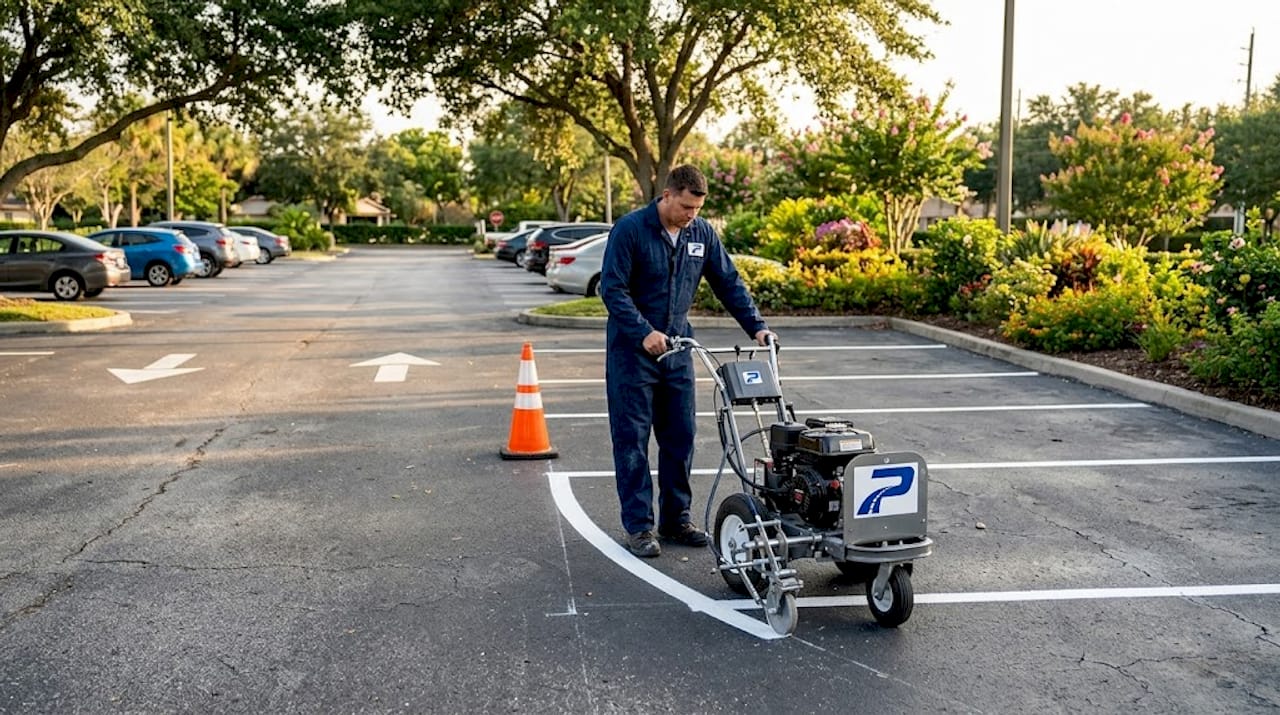
The big advantage is capacity. Because stalls are positioned straight on, you pack the most cars into a given footprint. Standard stall dimensions in commercial lots run 9 feet wide by 18 feet long, with 4-inch boundary lines. That geometry tiles efficiently across large, rectangular lots.
The trade-off is aisle width. Two-way aisles require a minimum of 24 feet to allow vehicles traveling in opposite directions to pass safely and to give drivers enough room to back out without blocking traffic. That width requirement eats into your total footprint more than a one-way design would.
Perpendicular layouts work best in these situations:
- Large employee parking lots where workers park for hours and capacity outweighs convenience
- Retail anchors or grocery stores with wide, rectangular lots that accommodate full two-way aisles comfortably
- Industrial facilities that need to fit the maximum number of vehicles in a defined area
One common mistake with this layout is underestimating how difficult backing out becomes during peak hours. When aisles fill with moving traffic, the perpendicular design creates more pedestrian conflict than an angled alternative. Improper stall widths or line thickness compounds this problem by reducing effective maneuvering room even when the aisles technically meet the minimum.
3. Example 2: 45- and 60-degree angled parking with one-way aisles
Angled parking layouts are the go-to choice for customer-facing properties where ease of use matters more than raw capacity. The stalls sit at either 45 or 60 degrees to the aisle, and traffic moves in one direction only.
The immediate benefit is how naturally drivers pull in and back out. The angle guides vehicles into the stall rather than requiring the driver to straighten out perpendicular to the aisle, which cuts down on corrective maneuvering and driver frustration. One-way aisles paired with angled stalls reduce conflict points and simplify circulation by eliminating head-on vehicle encounters within the aisle.
Aisle width requirements shrink considerably with this design. One-way aisles function safely at 12 to 18 feet, which can actually recover usable space compared to a full two-way aisle, even accounting for the slight stall count reduction.
Here is where each angle degree fits best:
- 45-degree layouts: Easiest ingress and egress, ideal for high-turnover retail or restaurant lots where drivers are stopping briefly and unfamiliar with the property
- 60-degree layouts: A middle-ground option that fits more stalls than a 45-degree design while still guiding drivers more naturally than perpendicular
Pro Tip: If you use a 45-degree angled layout, mark the circulation direction with bold directional arrows at every aisle entry. Drivers who miss the one-way pattern cause head-on conflicts that cancel out the flow advantages you designed in.
The main drawback of angled layouts is stall count. You will fit fewer cars per row compared to a 90-degree design. For a lot where capacity is critical, that trade-off may not pencil out.
4. Example 3: Mixed-use layouts with accessible parking, fire lanes, and loading zones
The most real-world examples of pavement striping layouts are not purely one type. They combine standard stalls with several regulated zones that each carry specific marking requirements. This is where most property managers run into trouble, because a one-size-fits-all approach to pavement marking fails almost every time a property has more than one function.
Here is how each zone should be handled in a mixed-use layout:
| Zone | Color | Key Requirement |
|---|---|---|
| Standard stalls | White | 9'x18' stall, 4-inch lines |
| Accessible (ADA) spaces | Blue | 60-inch access aisle; van spaces need 96-132 inch aisles |
| Fire lanes | Red | Local jurisdiction dictates exact wording and widths |
| Loading/no-parking zones | Yellow | Clear separation from main circulation aisles |
| Crosswalks | White | Connects pedestrian paths across drive aisles |
ADA accessible stalls require a 60-inch access aisle adjacent to each space. Van-accessible stalls need aisles up to 132 inches wide. Those stalls must sit closest to the building entrance, not shoved to a far corner to save space. ADA parking signs must be mounted with the bottom edge at a minimum of 60 inches above the ground so the sign remains visible over the hood of a parked vehicle.
Fire lanes follow local jurisdiction rules. Contractors must verify local codes before planning fire lane widths, wording, and colors, because requirements vary between municipalities. Loading zones belong on the perimeter of the circulation pattern, positioned so delivery vehicles do not block active drive aisles during operations.
5. Comparison of common pavement striping layout types
Choosing between layout types comes down to your specific priorities. This table gives you a side-by-side look at the three main pavement marking designs covered above.
| Layout Type | Stall Capacity | Aisle Width Needed | Best For | Main Limitation |
|---|---|---|---|---|
| 90-degree perpendicular | Highest | 24 feet (two-way) | Large lots, employee/industrial parking | Harder to maneuver, more pedestrian conflict |
| 45-degree angled | Lower | 12-18 feet (one-way) | Retail, short-term, high-turnover | Fewer stalls per row, requires directional arrows |
| 60-degree angled | Moderate | 15-18 feet (one-way) | Mixed retail/office, moderate traffic | Still requires one-way circulation discipline |
| Mixed-use | Varies | Varies by zone | Any commercial property with compliance needs | Most complex to plan and execute correctly |
No layout type wins across every category. The right choice depends on your lot dimensions, your tenant mix, and how your visitors use the space.
6. Situational guidance for choosing the right striping layout
Different properties call for different pavement striping layouts. Here is how to match layout type to your actual situation:
Small or irregular lots benefit most from 45-degree angled parking. The narrower one-way aisles recover space that would otherwise be consumed by two-way clearance requirements. Angled layouts also handle odd lot geometries better because rows do not need to be parallel to all four property lines.
Large, high-capacity lots should default to perpendicular layouts. The capacity advantage of the 90-degree design compounds across a large footprint. A lot with 200 stalls in a perpendicular layout might hold only 175 in a 45-degree configuration. Over the life of the property, that difference is significant.
Customer-facing properties like restaurants, banks, and medical offices should prioritize angled layouts. Drivers unfamiliar with the lot get in and out faster, which reduces congestion during peak periods. You can also visit Pinnaclepave's parking lot striping resources for visual layout examples that support planning discussions with your contractor.
Additional situational factors to weigh:
- Industrial or mixed-use sites: Loading zone placement is the first priority. Design the circulation pattern around the dock locations, not the other way around.
- High pedestrian volume sites: Add extra crosswalks and consider painted pedestrian corridors that cross drive aisles at right angles, not diagonal shortcuts.
- Maintenance and restriping costs: Professional striping requires specialized equipment including line striping machines and symbol templates. A layout with more complex markings costs more to maintain over time.
Pro Tip: If your lot needs restriping in the next 12 months, consult your striping contractor before making layout changes. Minor adjustments in stall angle or aisle width sometimes require sealcoating the existing lines first. Getting that sequence right saves you from visible ghost lines under your new markings.
For properties in Tennessee, understanding pavement marking types suited to local climate conditions also affects how long your chosen layout stays crisp and readable.
My honest take on where parking lot layouts go wrong
I have seen a lot of parking lots that were painted with skill but designed with no strategy at all. The lines are straight, the stalls are the right size, and somehow the lot still creates chaos every morning.
The most consistent culprit is layout decisions made on the day of the job. When a crew shows up with no flow diagram and a lot that has never been formally laid out, they default to what fits easiest, usually perpendicular stalls with whatever aisle width remains. That produces a functional-looking lot that develops real problems over time: an exit that becomes a blind turn, a fire lane that blocks the best access point, ADA stalls placed for convenience instead of compliance.
ADA signage mounting height is probably the most overlooked detail I encounter on commercial properties. You can have beautifully painted blue stalls with access aisles and van spaces, and then someone mounts the sign at 48 inches because that is where the post happened to land. That is a failed inspection and a liability exposure, no matter how good the paint job looks.
My honest advice is this: treat the layout conversation as the most important part of the project, not a formality before the striping crew arrives. Work with a contractor who asks about your traffic patterns, your tenant mix, and your compliance obligations before measuring a single stall. The difference between a lot that functions for ten years and one that creates headaches in year two almost always traces back to that planning conversation.
— Dillan
Get your parking lot layout done right with Pinnaclepave
Choosing the right striping layout is one decision. Executing it precisely, compliantly, and durably is another. Pinnaclepave handles both for commercial property owners across Tennessee.

From ADA compliance guidance to full parking lot restriping with professional-grade equipment and drone-documented results, the Pinnaclepave team brings the knowledge to design layouts that work for your specific property. Whether you need a simple restripe, a mixed-use layout with fire lanes and accessible stalls, or a complete lot redesign, the work gets done correctly the first time. Visit Pinnacle Pavement Solutions to request a quote and see what a properly planned striping project looks like from start to finish.
FAQ
What is the most space-efficient parking lot layout?
Perpendicular 90-degree parking maximizes the number of stalls per square foot, with standard stalls measuring 9 feet wide by 18 feet long. However, it requires two-way aisles at least 24 feet wide, which offsets some of that capacity gain on smaller lots.
How wide do parking lot aisles need to be?
Two-way drive aisles require a minimum of 24 feet for safe bidirectional traffic flow. One-way aisles paired with angled parking can function at 12 to 18 feet, depending on the stall angle used.
What do the different pavement marking colors mean?
White marks standard parking stalls and crosswalks, yellow designates no-parking and loading zones, blue identifies ADA accessible spaces, and red marks fire lanes. These color standards are widely recognized and expected by drivers and code inspectors alike.
Where must ADA accessible parking be located?
ADA accessible stalls must be placed at the shortest accessible route to the building entrance, not in a remote corner of the lot. Each stall requires a minimum 60-inch access aisle, and van-accessible spaces need aisles up to 132 inches wide.
How often should parking lot striping be repainted?
Most commercial parking lots need restriping every one to two years, depending on traffic volume, sun exposure, and the type of paint used. High-traffic lots or those in hot climates may need attention annually to keep markings visible and legally compliant.