

Most commercial property owners assume fresh paint is the only thing standing between their parking lot and chaos. That assumption can cost real money. Paint is one option among several, and in Tennessee's mix of heavy summer sun, occasional winter snow events, and high-traffic commercial corridors, it often isn't the best one. The material you choose, the function each marking serves, and how well you maintain retroreflectivity (the ability of a marking to bounce headlights back to drivers at night) are the factors that actually separate a safe, compliant property from one that creates liability. This guide lays out everything you need to decide wisely.
Table of Contents
- Understanding pavement marking types: Function and materials
- Comparing the main pavement marking materials
- Supplemental pavement marking devices: Raised markers and curb markings
- Safety and friction: What property owners need to know
- Our take: Smart pavement marking choices for modern Tennessee properties
- Enhance your property with professional pavement marking solutions
- Frequently asked questions
Key Takeaways
| Point | Details |
|---|---|
| Material matters | Choosing the right marking material is key to long-term visibility and durability. |
| Durability depends on traffic | High traffic and snow-plow areas need durable systems like thermoplastic or tape. |
| Retroreflectivity is crucial | Performance indicators like retroreflectivity offer more insight than initial appearance. |
| Safety goes beyond visibility | Marking friction can impact slip risk in wet weather and should be considered. |
| Supplemental devices boost safety | Raised markers and curb lines provide extra visibility, especially at night or in poor conditions. |
Understanding pavement marking types: Function and materials
Before you can choose the right material, you need to understand what each marking actually does. AASHTO/MUTCD-style practice categorizes pavement markings by two primary functions: longitudinal and transverse.
Longitudinal markings run parallel to traffic flow. Think lane lines, edge lines, and center lines. Their job is to guide drivers through a space without ambiguity, whether that's a multi-lane drive-thru approach or a two-way parking aisle.
Transverse markings cross the direction of travel. Stop bars, crosswalks, and yield lines fall into this category. These markings carry heavy safety weight because drivers depend on them in split-second situations.
Once you understand the function, you choose the material. Pavement marking materials fall into two broad families: paint and durable plastic systems. The durable plastics include:
- Liquid hot-applied thermoplastic: Melted and applied at high temperature, bonds tightly to asphalt or concrete
- Preformed fused thermoplastic: Pre-shaped symbols and legends that are heat-bonded to the surface
- Cold-applied preformed tape: Pressure-sensitive or adhesive-backed, no heat required
- Cold-applied MMA (methyl methacrylate): A two-component system that chemically cures, offering very high durability
Each material brings different performance characteristics. Understanding asphalt terminology helps you ask the right questions when getting quotes.
Here is a quick side-by-side on function versus material fit:
| Marking function | Best paint fit | Best durable plastic fit |
|---|---|---|
| Parking stall lines | Low-traffic lots | High-turnover retail, warehouses |
| Crosswalks | Temporary or low-use | Schools, busy intersections |
| Stop bars | Rarely adequate | Any public or commercial drive |
| Fire lane markings | Compliant short-term | Preferred for long-term compliance |
| Handicap symbols | Acceptable start | ADA-priority; thermoplastic preferred |
Pro Tip: If you are planning a new sealcoat, always schedule your striping project directly after. Fresh sealcoat bonds better with thermoplastic and extends the life of any marking system you apply. Refer to the Tennessee compliance guide for marking width and color requirements that apply to your property type.
Comparing the main pavement marking materials
With the main types and materials explained, let's directly compare their durability and performance for Tennessee conditions.
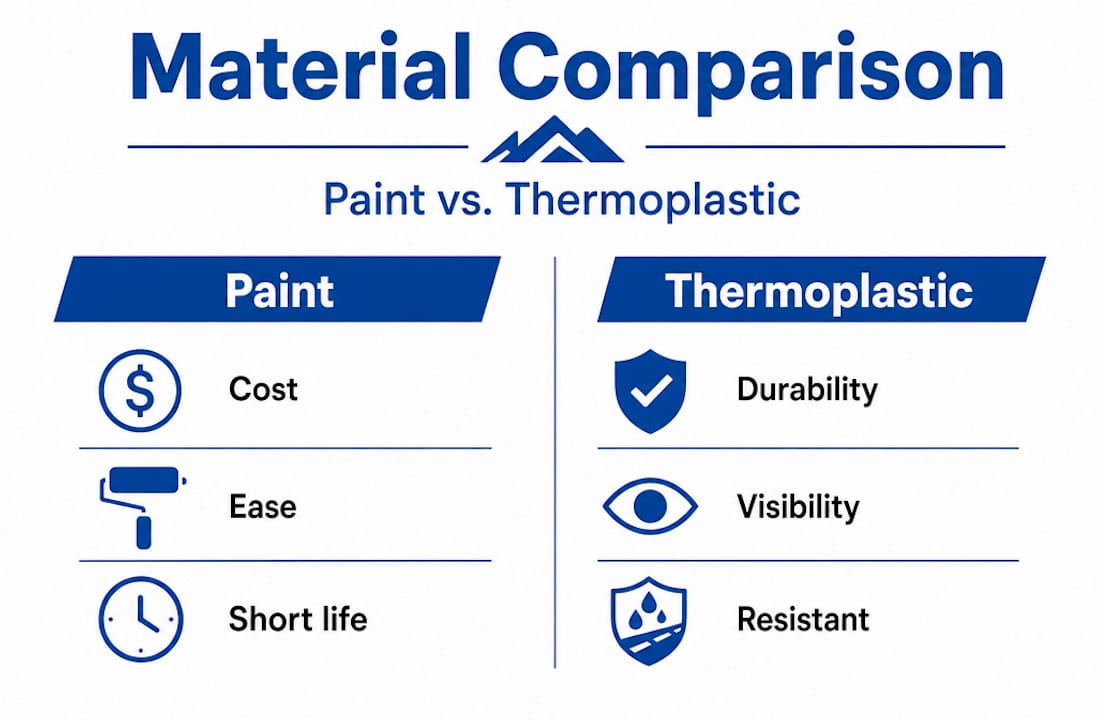
Paint gets a reputation for being the obvious choice because it's fast, affordable, and widely available. It does have a real place in the market. For a newly paved residential driveway or a storage facility with minimal traffic, standard waterborne paint will do the job. The problem is that paint durability drops sharply as traffic volume rises, and in any area that sees snow removal equipment, the abrasive scraping action destroys paint lines in a single season.
Durable striping systems are defined as having an expected life cycle of three years or more, measured by retroreflectivity scores collected in spring and fall. Waterborne paint falls below that threshold in most commercial applications, especially in East Tennessee where winter road treatment is more common.

Here's how the materials stack up across the metrics that matter most to property owners:
| Material | Expected life | Upfront cost | Retroreflectivity | Best use case |
|---|---|---|---|---|
| Waterborne paint | Under 1 year (high traffic) | Lowest | Fades quickly | Low-traffic, temp markings |
| Thermoplastic | 3 to 7 years | Moderate | Excellent with glass beads | Parking lots, roadways |
| Preformed tape | 3 to 5 years | Moderate to high | Very good | Symbols, logos, crosswalks |
| MMA | 5 to 10 years | Highest | Outstanding | High-wear zones, industrial |
Key considerations when reviewing this table for your specific property:
- Traffic volume matters more than property size. A small but busy fast-food drive-thru generates more wear per square foot than a large but low-turnover office lot.
- Snow plow routes demand durability. Any marking in a plow path should be thermoplastic or better.
- Retroreflectivity is not optional for nighttime safety. Every durable material incorporates glass beads during application to reflect headlights back to drivers. Paint with beads fades far faster than thermoplastic with beads.
- MMA is worth the investment for industrial floors. Warehouse lanes, dock approach markings, and forklift corridors endure punishment that renders paint invisible within weeks.
Pro Tip: Ask for retroreflectivity readings before and after any marking project. Contractors who use calibrated equipment to measure and document performance are giving you proof of value, not just a freshly painted surface. You can learn more about your full range of options in our thermoplastic marking guide.
One often-overlooked cost factor is the frequency of reapplication. A property owner who chooses paint at $0.10 per linear foot but restripes every eight months is paying more over five years than the owner who invested in thermoplastic at $0.40 per linear foot once. When you factor in the operational disruption of closing your lot for restriping, the math tilts even further toward durable systems. For context on how this fits into a broader surface maintenance decision, see our piece on sealcoat vs resurfacing.
Supplemental pavement marking devices: Raised markers and curb markings
Material choice is only half the challenge. Let's look at how supplemental devices strengthen your pavement marking plan.
Even the highest-quality thermoplastic marking can become invisible at night during heavy rain. This is where raised pavement markers (RPMs) earn their value. RPMs are physical devices mounted flush with or slightly above the pavement surface. They contain retroreflective faces that bounce light back to drivers from a different angle than flat paint or thermoplastic.
Raised pavement markers are used to supplement painted and thermoplastic markings, improving delineation in low-light and wet conditions. In snow-plow regions, snowplowable RPMs are specifically designed to survive blade contact by recessing into a protective housing when struck.
For Tennessee property owners, RPMs offer several practical benefits:
- Enhanced visibility on curved or poorly lit parking lot aisles
- Secondary delineation where tree cover or overhead lighting is limited
- Redundant guidance at drive-thru merge points and lane splits
- Improved pedestrian safety at low-speed crossing areas after dark
Curb markings also play an important supplemental role. Yellow curb paint designating no-parking zones, red curb for fire lane compliance, and reflective tape on parking structure pillars all feed into the same overall system. The curb line is often the last thing a driver sees before making a mistake, so keeping it visible matters.
Visibility is not a single product decision. It's a layered strategy. Flat markings handle the daylight and dry-weather load. Retroreflective devices handle the night and wet-weather load. A property that uses both systems together is fundamentally safer than one relying on either alone.
For Tennessee commercial properties that receive delivery trucks at night or operate extended hours, adding RPMs at key decision points is a low-cost, high-impact upgrade. Our parking lot striping services include consultation on where supplemental devices add the most value for your specific layout.
Safety and friction: What property owners need to know
Beyond visibility, friction is a core safety issue. Here's what you need to know for your property.
Most property owners think about pavement markings in terms of what they look like. Fewer think about what they feel like under a shoe or tire. That gap in awareness creates real liability exposure. Research on friction differentials confirms that pavement markings and colored pavement surfaces can have meaningfully different friction characteristics from the surrounding pavement, and the gap widens under wet conditions.
Thermoplastic applied too thickly, epoxy-based colored pavement, and some preformed tapes can all create surfaces that are noticeably slicker than bare asphalt when wet. This matters most in pedestrian zones: crosswalks, building entrances, accessible routes, and loading dock approaches where foot traffic is regular.
Here is a practical checklist for evaluating friction safety across your marking plan:
- Identify pedestrian crossings and building entry paths where any elevated marking material will receive heavy foot traffic.
- Specify high-grit aggregate or anti-slip additives for colored or epoxy-based markings in those zones.
- Request friction testing documentation from your contractor on any specialty material being applied to a pedestrian surface.
- Inspect markings after the first significant rain. A slick marking is a liability. Catching it early means you can apply a grit surfacing before a claim happens.
- Replace worn-smooth markings promptly. Even a marking that was applied with adequate friction can become hazardous once the surface texture wears down.
Pro Tip: For high-pedestrian areas like ADA access aisles and building entry crosswalks, specify thermoplastic with added anti-slip beads or a grit broadcast instead of smooth paint or colored epoxy. It costs slightly more upfront and protects you from a slip-and-fall scenario that costs far more. Our team at roadway marking projects regularly incorporates friction considerations into material selection for exactly this reason.
The friction issue also extends to drive-thru lanes and parking approaches. Vehicle tires lose some braking efficiency over thick marking films, which is another reason that properly specified thermoplastic with calibrated thickness is better than improvised paint layers stacked over years of restriping.
Our take: Smart pavement marking choices for modern Tennessee properties
The most common mistake we see on Tennessee commercial properties is using paint everywhere because it's familiar and cheap upfront. Property managers often make that decision without calculating what it truly costs over five years, including restriping labor, lot closures, and the ongoing risk of faded markings creating liability.
Here is the uncomfortable truth: a faded stop bar or invisible crosswalk does not protect you legally. It actually strengthens a plaintiff's case. A documented, durable, retroreflective marking program does the opposite. It shows that you took your obligation seriously and maintained your property to a reasonable standard.
Tennessee's weather adds complexity that other markets don't face at the same level. The middle and eastern parts of the state deal with enough winter precipitation to require snow removal equipment, and that equipment destroys paint aggressively. West Tennessee gets less snow but endures intense summer heat that accelerates paint fade and adhesion failure. No single marking material serves the entire state identically.
Our approach is to start every project by asking four questions. What is the traffic volume and type? What equipment services this pavement in winter? What are the pedestrian exposure points? And what is the realistic maintenance schedule this property owner will follow? Matching material to those answers produces markings that last and that protect both the property owner and the people using the space.
The benchmark we use to evaluate quality over time is retroreflectivity. If your markings still reflect well at 18 months, you chose the right material and it was applied correctly. If they're faded and barely visible, you're already behind. Long-lasting parking lot markings are not an accident. They are the result of deliberate material selection and professional installation from the start.
Enhance your property with professional pavement marking solutions
Applying the right marking system to your Tennessee property takes more than picking a color and calling a contractor. It requires genuine knowledge of traffic loads, material performance, ADA compliance, and local conditions that affect long-term durability.
Pinnacle Pavement Solutions brings that knowledge to every project, whether you need parking lot marking services for a busy retail center, DOT-grade thermoplastic solutions for drive-thru approaches and stop bars, or a complete restriping program after fresh sealcoating. We document our work with drone photography so you have visual proof of the finished product before we leave the site. Browse our project gallery to see the level of quality we deliver, then reach out for a straightforward quote with honest pricing and no surprises.
Frequently asked questions
What is the difference between longitudinal and transverse pavement markings?
Longitudinal markings run parallel to traffic, like lane lines, while transverse markings cross the direction of travel, such as stop bars and crosswalks.
How long does paint-based pavement marking typically last?
Paint durability can drop to just two to three months in high-traffic or snow-removal areas, though it may last longer in very low-traffic settings.
What makes thermoplastic and tape systems more durable?
Thermoplastic and tape systems bond deeply to the pavement surface and are engineered to meet durable striping standards of three or more years based on retroreflectivity performance.
Are raised pavement markers required for Tennessee properties?
Raised markers are not universally required, but RPMs supplement flat markings for significantly better nighttime and wet-weather visibility, especially in high-traffic or snow-prone areas.
Do pavement markings affect wet-weather safety?
Yes. Different friction characteristics between marking materials and surrounding pavement create slip risks under wet conditions, making proper material selection critical for pedestrian and vehicle safety.