
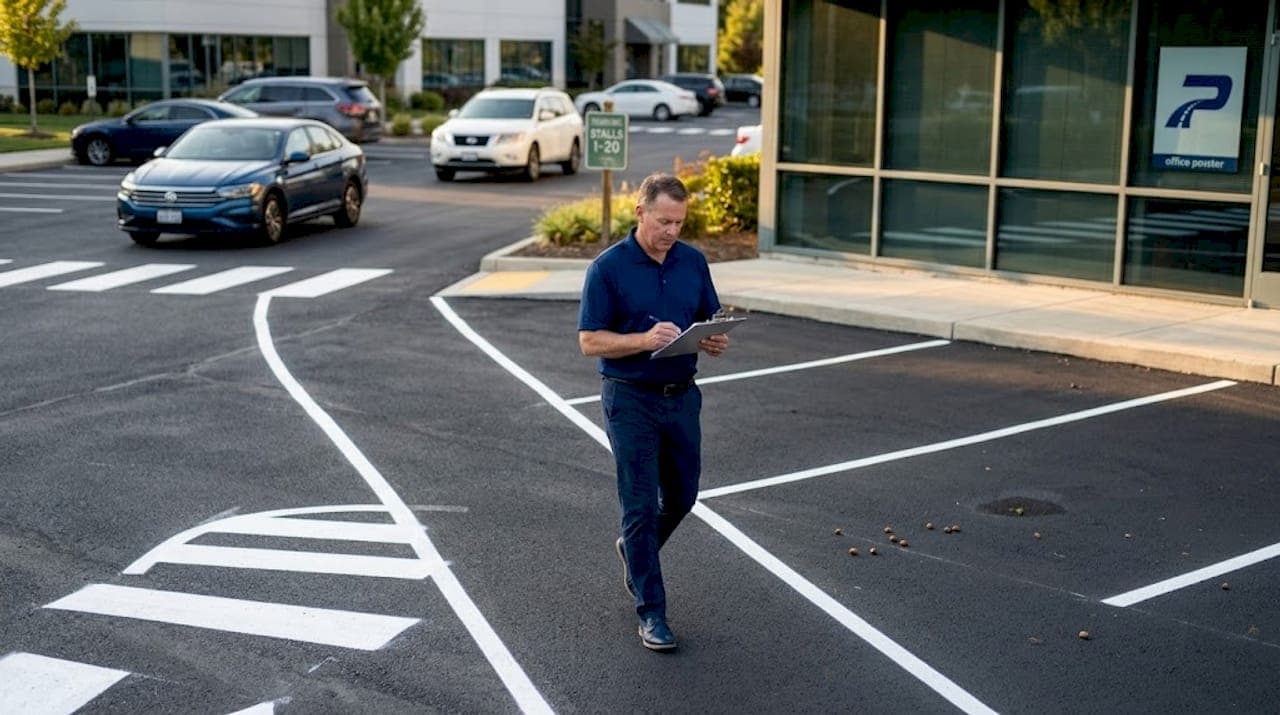
Worn, faded markings don't just look bad. They create genuine safety hazards, invite compliance violations, and send a clear message to anyone who visits your property: this place isn't managed with care. The benefits of regular striping go far beyond aesthetics. Fresh, visible markings define traffic flow, protect pedestrians, keep you on the right side of ADA regulations, and even contribute to healthier turf in adjacent lawn areas. If you manage a commercial parking lot, a shared driveway, or any paved surface that sees regular traffic, understanding what regular striping actually does for your property is worth your time.
Table of Contents
- Key takeaways
- 1. Sharper safety for every person on your property
- 2. Curb appeal that actually reflects on your business
- 3. Staying compliant with ADA and local regulations
- 4. Healthier turf through consistent lawn striping
- 5. Maximizing space efficiency through smart layout
- 6. Choosing the right frequency and materials
- My take: striping is operational infrastructure, not decoration
- Ready to restripe? Pinnaclepave makes it straightforward
- FAQ
Key takeaways
| Point | Details |
|---|---|
| Safety comes first | Clear lane markings and crosswalks reduce driver confusion and pedestrian conflicts immediately. |
| Compliance is ongoing | Regular restriping lets you verify ADA layout accuracy and avoid fines before they happen. |
| Curb appeal is measurable | Fresh markings make even older asphalt surfaces look cleaner and more professionally managed. |
| Lawn striping builds turf health | Alternating mowing direction prevents grain, improves sunlight exposure, and thickens grass over time. |
| Frequency depends on context | Traffic volume, climate, and pavement type all influence how often restriping should happen. |
1. Sharper safety for every person on your property
This is where the advantages of regular striping are most immediate and most quantifiable. When lines fade, drivers improvise. They create their own paths, park at odd angles, cut through pedestrian zones, and generate the kind of unpredictable movement that leads to close calls and minor collisions.
Fresh striping reduces hesitation and wrong-way movements by giving drivers clear arrows, defined lanes, and obvious stop points. That's not a small thing in a busy lot. It's the difference between a predictable traffic pattern and a free-for-all where everyone guesses.
Pedestrians benefit just as directly. Crosswalks, safety zones, and pedestrian paths that are clearly marked keep foot traffic separated from vehicle lanes. For retail centers, medical facilities, and any property where customers walk to and from their vehicles, this matters every single day.
A few specific safety gains worth noting:
- Defined entry and exit lanes eliminate wrong-way entry, which is one of the most common causes of parking lot accidents
- Clearly marked stop bars give drivers consistent stopping cues at intersections and driveways
- Separated pedestrian crosswalks reduce pedestrian exposure to moving vehicles
- Accessible path markings keep wheelchair users and people with mobility challenges on safe, predictable routes
Pro Tip: If your lot handles drive-thru traffic alongside regular parking, separate striping for those lanes is not optional. Mixed traffic without clear separation is one of the highest-risk configurations a property can have.
2. Curb appeal that actually reflects on your business
First impressions happen before anyone walks through your door. A parking lot with bright, fresh markings signals that the people running this property pay attention to details. A lot with ghost lines and half-visible stalls signals the opposite.
Fresh, sharp markings create a cleaner look and communicate that a property is actively maintained. Faded lines, by contrast, communicate neglect. That perception travels inside with every customer, tenant, and visitor who parks on your surface.
There's a practical side to this beyond appearances. Visual contrast from fresh striping actually masks wear marks, tire scuffs, and surface discoloration on older asphalt. You don't need a full repaving project to make your lot look significantly better. A quality restripe accomplishes a meaningful portion of that visual reset at a fraction of the cost.
Well-maintained striping also changes how people park:
- Clearly defined stalls reduce the diagonal parking that leads to door dings and wasted space
- Directional arrows prevent nose-to-nose standoffs in two-way aisles
- Neatly organized rows make the lot feel larger and easier to navigate
For commercial landlords and franchise operators, consistent striping across multiple properties builds brand credibility. It shows that standards are upheld at every location, not just the flagship.
3. Staying compliant with ADA and local regulations
Compliance is the striping benefit most property owners ignore until something goes wrong. ADA guidelines are specific about accessible parking stall dimensions, access aisle widths, signage placement, and surface markings. Those markings fade. When they do, you're no longer compliant, even if the physical layout is still correct.
Faded markings drift away from ADA compliance, and the consequences can include fines, complaints, and liability exposure in the event of an incident involving a person with a disability.
Here's what a regular restriping program protects you against:
- Inaccessible stalls. Without clearly marked access aisles, van-accessible stalls are effectively unusable. A restripe restores usability and compliance at once.
- Fire lane violations. Faded fire lane markings are a code enforcement issue in most jurisdictions. Local fire marshals cite properties for exactly this.
- Loading zone confusion. Unmarked or faded loading zones get used as overflow parking, which creates operational and safety problems.
- Layout drift. Restriping is also the right time to review your parking layout and correct anything that no longer meets current code or lot usage patterns.
If you operate in Tennessee, the ADA compliance requirements for parking lot markings are worth reviewing before your next restripe. Requirements around accessible space counts, signage, and aisle widths have specifics that change based on lot size and use type.
4. Healthier turf through consistent lawn striping
The importance of lawn striping goes well beyond creating a baseball-field look in your front yard. There are real turf health benefits that property managers often overlook when evaluating their lawn maintenance approach.
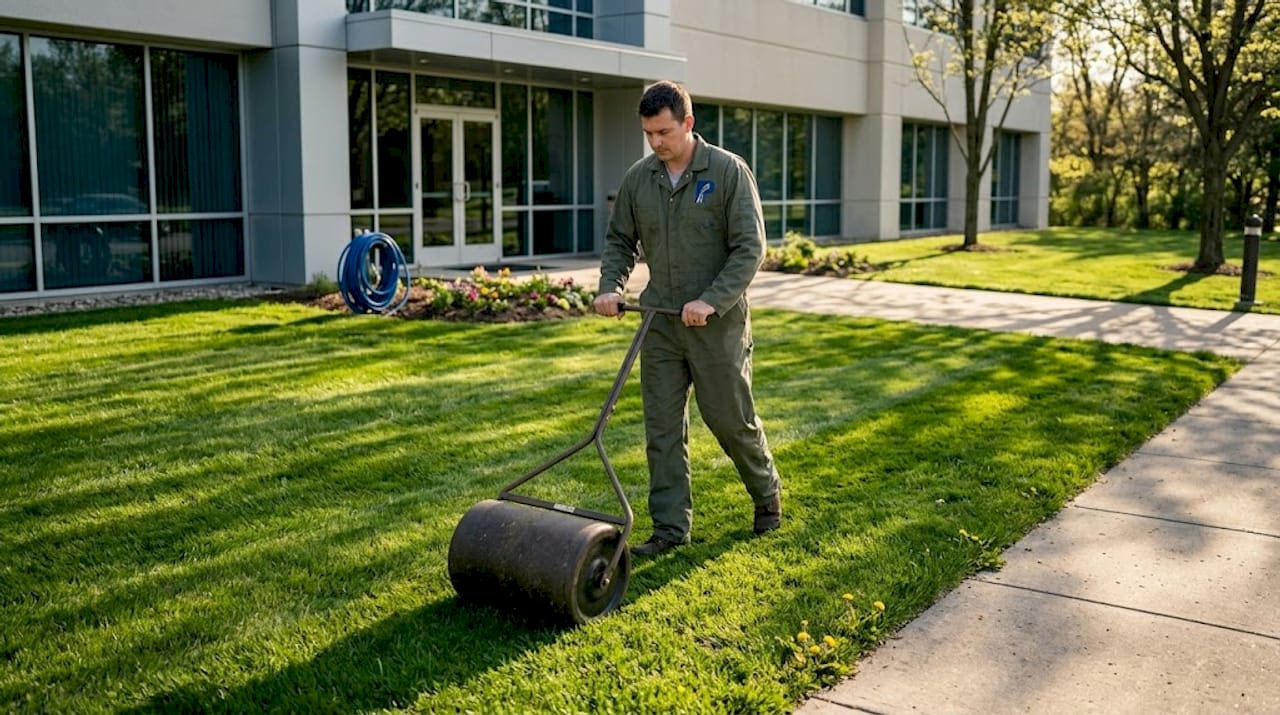
Lawn striping works by bending grass blades in alternating directions as you mow. Alternating mowing direction prevents a permanent lean, called grain, which shades lower parts of the blade and reduces sunlight absorption. When blades stay consistently bent in one direction, the turf weakens over time. Rotating the pattern forces upright growth and healthier root development.
| Lawn condition | Single-direction mowing | Regular striping (alternating direction) |
|---|---|---|
| Grass blade orientation | Develops permanent grain | Stays upright and balanced |
| Sunlight penetration | Reduced by self-shading | Improved, more even distribution |
| Turf thickness | Thins over time | Builds density and weed resistance |
| Surface appearance | Flat, uniform color | Visual contrast with light and dark bands |
How striping improves turf isn't complicated. More sunlight reaches more of each blade. The grass grows thicker. Thicker turf crowds out weeds and handles drought, foot traffic, and seasonal stress better than thin, grained turf does.
Pro Tip: To maximize stripe visibility, adjust mowing height slightly higher than your usual setting. Taller blades bend more dramatically and hold the striped pattern longer between mowing sessions.
The visual appeal is a real bonus for commercial properties. Striped turf adjacent to a freshly restriped parking lot creates a polished, coordinated property presentation that most competitors simply don't bother achieving.
5. Maximizing space efficiency through smart layout
One underappreciated benefit of regular striping is the opportunity it creates to rethink your layout. Most property managers restripe what was already there. The smart ones use each restripe as a chance to ask whether that layout is still the right one.
Traffic patterns change. Businesses expand. Drive-thru lanes get added. Delivery volumes shift. A parking lot layout that made sense five years ago might be creating bottlenecks or wasting space today. For examples of how different lot configurations handle these challenges, striping layout examples can help you visualize better options before paint hits the pavement.
Efficient striping layouts extract more usable stalls from the same square footage, direct traffic predictably to reduce congestion, and separate incompatible uses like customer parking, employee parking, and delivery access.
6. Choosing the right frequency and materials
Not every property needs restriping on the same schedule. The right interval depends on several factors that vary widely across different sites and climates.
| Factor | Impact on striping lifespan |
|---|---|
| Traffic volume | High-traffic lots fade faster; annual restriping is common |
| Climate and UV exposure | Sun and freeze-thaw cycles degrade paint faster |
| Pavement surface condition | Rough or porous surfaces absorb less paint and show wear sooner |
| Paint type used | Water-based paint lasts 1 to 2 years; thermoplastic lasts 3 to 7 years |
A practical framework for prioritizing your restriping budget:
- Address fire lanes and ADA-accessible stalls first. These carry the highest compliance and safety risk when faded.
- Restripe entrance lanes and directional arrows next. Confusion at entry points creates downstream problems throughout the entire lot.
- Tackle regular parking stalls and pedestrian crosswalks on the same project if budget allows.
- Consider thermoplastic markings for high-wear areas like stop bars and crosswalks where durability matters more than cost per application.
For properties that want to protect the pavement beneath those markings, pairing restriping with sealcoating services dramatically extends the life of both the surface and the paint. Sealed pavement gives paint a cleaner, less porous surface to bond to, which means brighter lines that last longer.
Pro Tip: Schedule your restripe immediately after a sealcoat application, once the sealer has fully cured. This sequence gives you maximum paint adhesion and the longest possible time before the next cycle.
My take: striping is operational infrastructure, not decoration
I've watched property managers spend significant money on landscaping, signage, and exterior lighting while letting their parking lot striping fade to nothing. The thought seems to be that paint is cosmetic. It's not.
In my experience, faded striping is almost always a precursor to a more expensive problem. Someone gets clipped in a poorly defined lane. A fire marshal issues a citation for an illegible fire lane. A tenant complains that the accessible spaces don't meet requirements. These are not hypothetical outcomes. They happen regularly, and they're entirely preventable.
What I've learned from working with commercial properties of all sizes is that properly maintained striping functions as operational infrastructure. It governs how people move through your property, how your layout performs under real conditions, and how you're perceived by everyone who uses the space.
The properties that treat restriping as a line item in their annual maintenance budget, rather than an emergency fix when things get bad enough, consistently look better, perform better, and avoid the kinds of incidents that cost far more than a restripe ever would.
My advice: get eyes on your striping twice a year. Spring and fall are natural checkpoints. You don't need a contractor every visit. You need someone who will look critically at what's fading, what's missing, and what's no longer serving the actual traffic patterns on your property.
— Dillan
Ready to restripe? Pinnaclepave makes it straightforward
If your parking lot is showing ghost lines, worn crosswalks, or markings that no longer meet ADA requirements, the right next step is a professional assessment from a crew that knows what to look for.
Pinnaclepave provides professional parking lot striping for commercial properties, municipalities, warehouse facilities, and residential clients across Tennessee. From standard stall layouts and directional arrows to thermoplastic stop bars, ADA-compliant handicap markings, and fire lane designations, every project is executed with professional-grade equipment and documented results. Pinnaclepave also handles pavement coatings and full asphalt maintenance, so your surface and your markings are treated as a complete system. Contact Pinnaclepave to schedule a property evaluation and get a clear plan for keeping your lot safe, compliant, and sharp.
FAQ
How often should parking lot striping be redone?
Most commercial lots benefit from restriping every one to two years, though high-traffic surfaces may need annual attention. Climate, pavement condition, and the type of paint used all affect how quickly markings fade.
What are the main benefits of regular striping for safety?
Fresh striping guides vehicles and pedestrians clearly through defined lanes, crosswalks, and stop points, reducing confusion and the driver improvisation that leads to accidents and close calls.
Does lawn striping actually help grass grow better?
Yes. Lawn striping prevents grass grain by alternating mowing direction, which improves sunlight penetration, encourages upright blade growth, and builds thicker, more resilient turf over time.
Can faded striping create legal liability?
Absolutely. Faded accessible stall markings and fire lane designations can put a property out of ADA and local code compliance, exposing owners to fines and liability if an incident occurs in an unmarked area.
What type of striping paint lasts the longest?
Thermoplastic markings last three to seven years in typical conditions, significantly outperforming water-based traffic paint. They are the best choice for high-wear zones like crosswalks, stop bars, and fire lanes.