
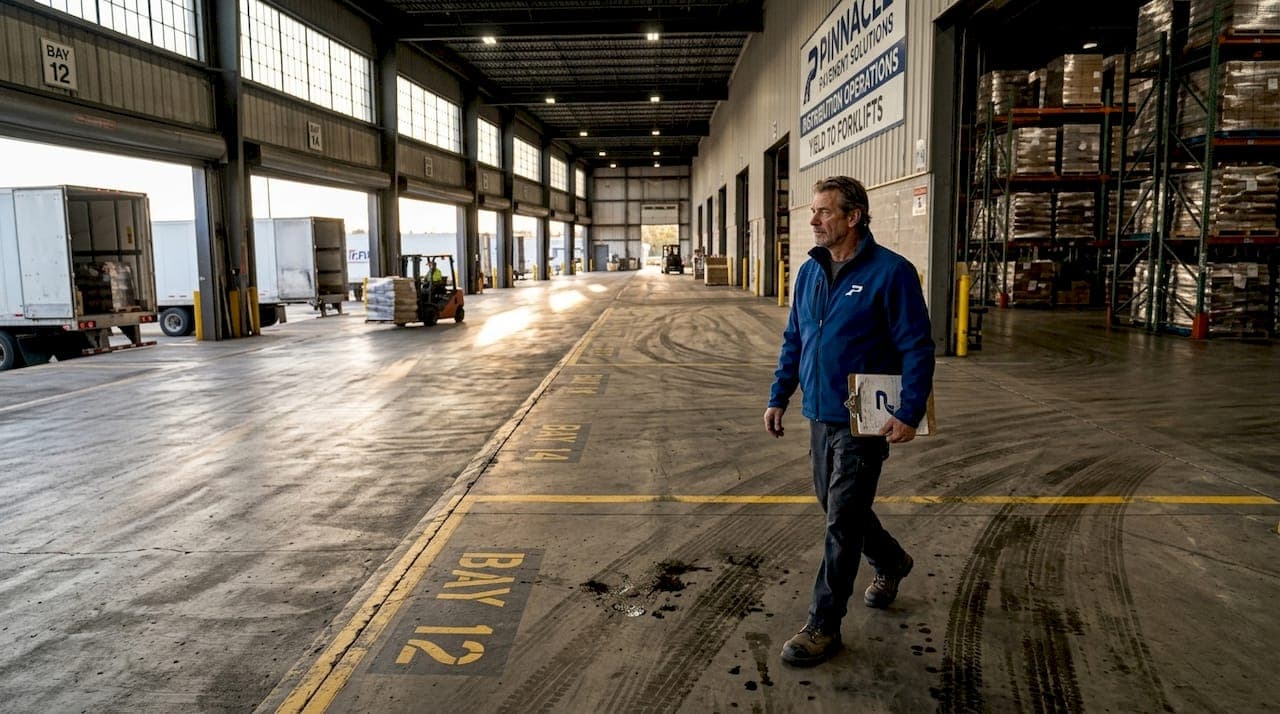
Most facilities managers assume that if a surface can hold a loaded semi-truck, it's good enough. That assumption costs money. Distribution facility pavement needs are fundamentally different from standard commercial paving, and getting the design wrong creates a chain reaction: damaged forklifts, slowed throughput, worker injuries, and expensive emergency repairs. This guide gives you the specific knowledge to evaluate your current pavement, understand what your operation actually demands, and make informed decisions about materials, maintenance, and design before the next crack becomes a capital expense.
Table of Contents
- Key takeaways
- Understanding distribution facility pavement needs
- Concrete vs. asphalt for distribution centers
- Pavement maintenance strategies that actually work
- Designing for efficiency: flatness, drainage, and layout
- What I have learned managing distribution facility pavement
- How Pinnaclepave can support your facility
- FAQ
Key takeaways
| Point | Details |
|---|---|
| Joints drive lifecycle costs | Poor joint design and filler selection cause more pavement failures than surface wear in distribution centers. |
| Material choice is load-specific | Concrete and asphalt each perform differently under heavy axle loads; your traffic profile should dictate the decision. |
| Flatness directly affects productivity | Floor flatness metrics (FF/FL) have a measurable impact on forklift efficiency, safety, and equipment wear. |
| Proactive maintenance pays off | Sealcoating, crack filling, and joint protection prevent costly structural repairs and extend pavement lifespan significantly. |
| Drainage design is non-negotiable | Loading dock aprons without proper drainage suffer accelerated freeze-thaw damage and edge deterioration. |
Understanding distribution facility pavement needs
When you characterize traffic in a distribution center, you are not just counting trucks. You are measuring axle load spectra, vehicle types, turning radius patterns, and daily cycle counts. A facility receiving 150 trailer moves per day faces fundamentally different structural demands than a light manufacturing plant with occasional delivery traffic. Cluster-based traffic inputs using localized AADT data produce far more reliable structural number (SN) estimates than generic national datasets. That difference in SN can translate to several inches of pavement thickness and years of additional service life.
The structural design has to account for where the real punishment happens. Loading dock aprons take the hardest hits: repeated trailer nose loading, brake forces, and the constant scrubbing of hard-wheel forklifts running tight patterns. Joints and edge details prevent scaling, edge breaks, and settlement in dock areas more reliably than surface thickness alone. Designing purely for forklift floor loads while ignoring dock-area dynamics is one of the most common planning gaps Pinnaclepave encounters on industrial sites.
Material selection follows traffic characterization, not the other way around. Once you know your axle load distribution, turning frequency, and dock usage intensity, you can evaluate concrete versus asphalt against real operational data rather than budget alone. This is the foundation of a sound industrial paving assessment.
- Axle load spectra: Document your heaviest regular vehicles, not just the average load. Design to the top percentile of your actual traffic.
- Usage zones: Separate traffic patterns for dock aprons, internal drive lanes, parking fields, and trailer staging areas. Each zone carries different load and frequency profiles.
- Subgrade condition: Weak or poorly compacted subgrade undermines even well-designed surface layers. Soil bearing capacity tests are required before finalizing any pavement section.
- Environmental exposure: Freeze-thaw cycles, rainfall intensity, and temperature swings all affect how each material performs over its service life.
Pro Tip: Before any paving project, request a full traffic characterization report from your contractor. If they cannot produce one, that tells you something important about their process.
Concrete vs. asphalt for distribution centers
Choosing between concrete and asphalt for a distribution center is not a simple cost comparison. Both materials perform well under the right conditions. Both fail badly under the wrong ones.
Concrete's core advantage in high-traffic industrial settings is its load-bearing rigidity. It distributes loads across a wide area and resists the rutting that asphalt can develop under stationary heavy loads, such as parked trailers sitting on the same spot for hours. Steel fibre reinforced concrete (SFRC) floors push this further by enabling panels up to 40 to 50 meters wide with steel-armored joints only at edges. That dramatically reduces the number of joints across the floor, which directly reduces the number of failure points. SFRC also reduces slab thickness requirements compared to traditional mesh reinforcement, cutting material costs and environmental impact simultaneously.
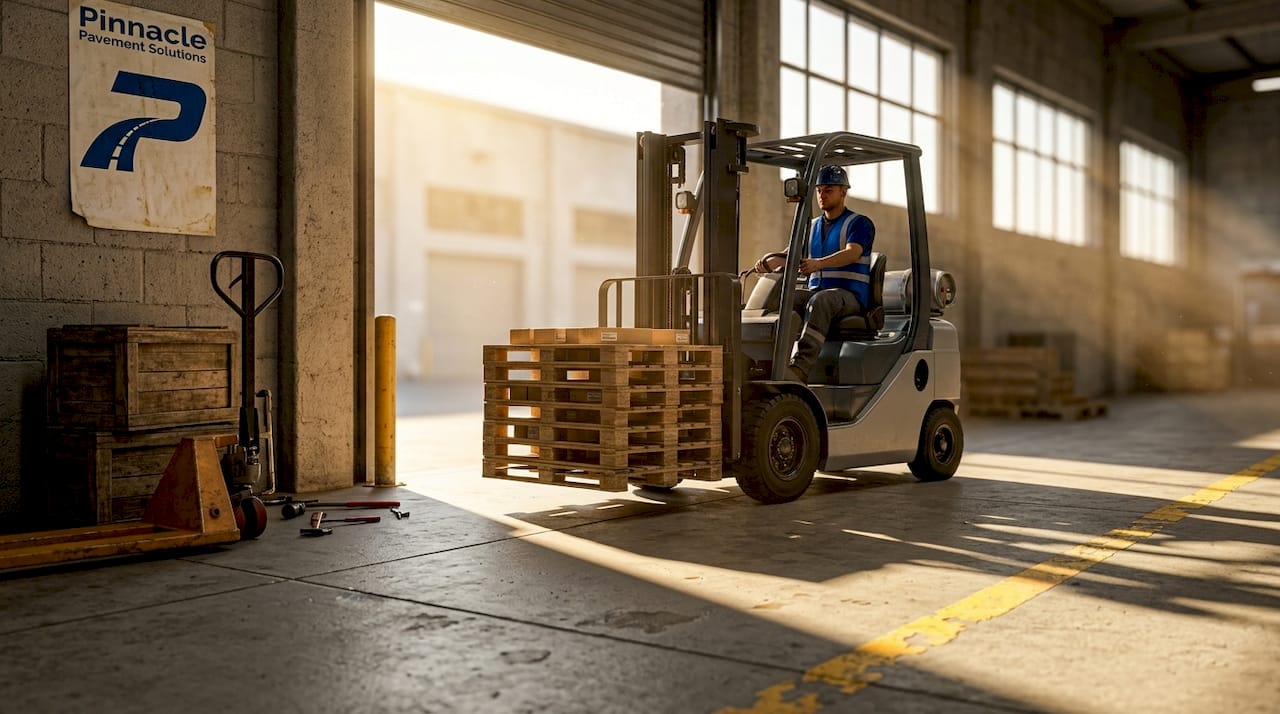
Asphalt's advantage is flexibility. It handles ground movement better than rigid concrete, making it a strong choice for outdoor lots, staging yards, and access roads where subgrade settlement is a realistic concern. Polymer-modified asphalt mixes create an elastic matrix that rebounds under heavy load rather than deforming permanently. Recycled asphalt content has also improved significantly, lowering maintenance needs compared to unbound aggregate surfaces while reducing material costs.
Pro Tip: For dock apron surfaces specifically, concrete wins almost every time. The combination of hard-wheel forklift traffic, trailer nose loading, and water exposure makes asphalt's flexibility a liability rather than an asset in that zone.
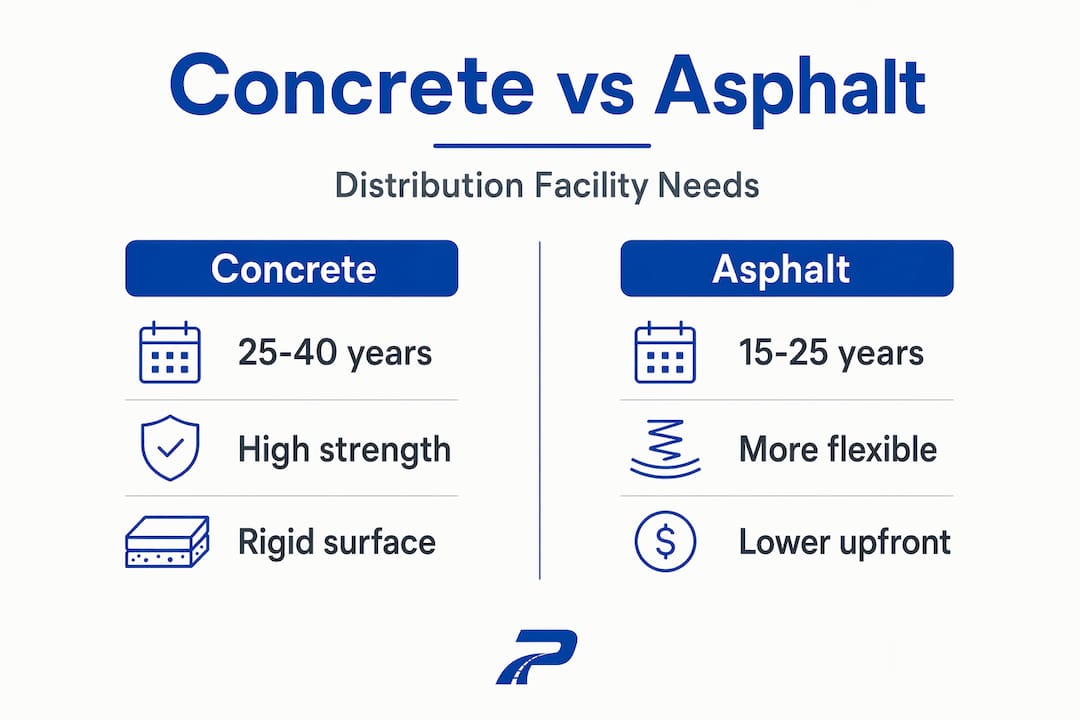
| Factor | Concrete | Asphalt |
|---|---|---|
| Typical lifespan | 25 to 40 years | 15 to 25 years |
| Upfront cost | Higher | Lower |
| Maintenance frequency | Lower | Higher |
| Joint behavior | Requires careful detailing | Fewer joint concerns |
| Repairability | Difficult, visible patches | Easier, cleaner repairs |
| Performance under stationary loads | Excellent | Moderate (rutting risk) |
| Freeze-thaw sensitivity | Moderate (joint-dependent) | Low to moderate |
The real answer for most large distribution facilities is a hybrid approach. Concrete for interior floors, dock aprons, and high-cycle drive lanes. Asphalt for parking fields, trailer lots, and perimeter roads. Matching the material to the zone rather than applying one solution across the entire property is the decision that separates adequate facilities from well-engineered ones.
Pavement maintenance strategies that actually work
Reactive maintenance in a distribution center is expensive in ways that do not always show up on a single invoice. A forklift damaged by a rough joint, a driver injury from an uneven dock apron, or a shutdown while emergency repairs block a critical lane all carry costs that dwarf the price of a proactive sealing program.
The highest-leverage maintenance investment you can make is joint protection. Semi-rigid joint fillers minimize wear and edge damage specifically in hard-wheel traffic zones. Standard flexible sealants compress and extrude under forklift wheel loads; semi-rigid materials maintain enough stiffness to support the wheel edge as it crosses the joint. Replacing the wrong filler type is one of the fastest ways to restart a damage cycle you thought you had fixed.
Beyond joints, a structured maintenance program for distribution center paving solutions typically includes the following elements:
- Sealcoating and surface treatments: Pavement coatings protect asphalt surfaces from oxidation, fuel spills, and UV degradation. Applied on a regular cycle, they significantly extend the time between major resurfacing projects.
- Crack filling: Addressed early, cracks are a minor expense. Left open through a freeze-thaw cycle, they become full-depth failures requiring section removal and replacement.
- Routine inspections: Schedule formal walk-throughs of dock aprons, drive lanes, and high-traffic floor areas at least twice per year. Document findings with photos so you can track progression rates.
- Joint re-filling cycles: Even well-installed joint filler has a service life. Plan for periodic inspection and replacement before filler extrusion or debonding allows water infiltration.
- Subgrade monitoring: Settlement under dock areas is gradual but progressive. Early detection through elevation surveys allows grouting or base repair before surface failure becomes visible.
The cost-benefit math is not complicated. Sealcoating a 50,000-square-foot lot costs a fraction of milling and repaving even a portion of it. Every dollar spent on proactive pavement maintenance strategies typically returns three to five dollars in deferred capital expenditure. Check out parking lot maintenance principles to understand how these fundamentals apply to your outer perimeter surfaces as well.
Designing for efficiency: flatness, drainage, and layout
A pavement that meets structural requirements but fails on flatness will still slow your operation down. Higher FF/FL flatness values directly reduce vehicle wear and improve both safety and productivity, particularly for narrow-aisle forklifts and automated guided vehicles (AGVs). When you spec a new floor or evaluate an existing one, flatness is not cosmetic. It is operational infrastructure.
Here is how to approach the three critical design dimensions for operational efficiency:
-
Specify flatness by use zone. AGV lanes and very narrow aisle (VNA) racking areas require the tightest tolerances, typically FF 50 or higher. Standard forklift aisles can tolerate lower values. Applying the same specification across the entire floor wastes money in low-demand zones and risks under-specifying where it matters most.
-
Design drainage before the slab goes down. Poor drainage at dock aprons encourages edge breaks and settlement that are expensive to correct after construction. Trench drains, sloped aprons, and perimeter channels need to be part of the original design, not afterthoughts.
-
Plan joint placement around traffic flow. Joints perpendicular to forklift travel directions take the most punishment. Where possible, orient panel layouts so joints run parallel to primary traffic paths. Timely saw-cutting during curing controls where shrinkage cracks form, giving you predictable joint locations rather than random cracking through your highest-use zones.
-
Account for racking loads in floor design. High-bay racking transfers point loads through narrow base plates directly into the slab. Floor panels need to be designed with these concentrated loads in mind, not just distributed vehicle traffic. Coordination between the racking engineer and the pavement designer is required, not optional.
-
Assess thermal movement paths. Large concrete floor slabs move seasonally. If expansion and contraction are not accounted for in joint spacing, the slab finds its own relief path, usually through a random crack across your busiest aisle at the worst possible time.
What I have learned managing distribution facility pavement
I have seen facilities spend significant money on high-quality concrete floor systems and then watch them deteriorate within five years because nobody paid attention to the joints. Specifically, because the wrong filler was specified, installed by a crew that did not understand why it mattered, and never inspected afterward. Joint behavior is the dominant distress mechanism in busy distribution facilities. That is not an opinion. That is the consistent finding from facility after facility, and it still gets treated as a secondary detail at the design stage.
My honest take: the upfront investment question is real, but it is being asked in the wrong frame. Facilities managers compare concrete versus asphalt costs at time zero. The more useful comparison is total cost of ownership across a 20-year horizon, including the downtime costs when a failed joint halts a forklift lane during peak season. Operators routinely underestimate the lifecycle savings from investing in better joint detailing and fiber reinforcement up front.
What actually works is treating pavement as operational infrastructure with the same rigor you apply to your conveyor systems or dock levelers. That means budgeting for it, scheduling its maintenance, and keeping records. The facilities I have seen get the longest service life from their pavements are not the ones with the biggest initial budgets. They are the ones with a maintenance program that gets followed.
— Dillan
How Pinnaclepave can support your facility
Pinnaclepave brings industrial paving experience directly to distribution facilities across Tennessee and the Southeast. Whether you need a full-depth asphalt paving project for your trailer staging yard, sealcoating and crack repair for your dock aprons, or thermoplastic roadway markings for drive-lane safety and traffic flow, the Pinnaclepave team delivers with professional-grade equipment and drone-documented results on every job. From industrial paving assessments to ongoing pavement maintenance programs, we build plans around your traffic, your loads, and your operational schedule. Visit Pinnacle Pavement Solutions to request an on-site evaluation and get a straight-talking assessment of what your facility actually needs.
FAQ
What are the biggest pavement requirements for warehouses?
The most critical pavement requirements for warehouses include adequate structural thickness for heavy axle loads, proper joint design and filler selection, flatness tolerances appropriate for your equipment type, and drainage systems that prevent water infiltration at dock aprons.
How do I assess pavement needs for a distribution center?
Start with a traffic characterization study that documents axle loads, vehicle types, and usage intensity by zone. Combine that with a subgrade bearing capacity test and a condition survey of existing surfaces to establish a baseline before specifying any repairs or new construction.
What is the best material for distribution facility pavements?
There is no single best material. Concrete performs better for interior floors, dock aprons, and high-cycle drive lanes because of its rigidity under stationary loads. Asphalt is more cost-effective and repair-friendly for parking fields, staging yards, and perimeter roads.
How often should joint fillers be replaced in a warehouse floor?
Joint filler inspection should occur at least twice per year in high-traffic areas. Replacement intervals depend on traffic intensity and filler type, but semi-rigid fillers in hard-wheel zones typically require attention every two to four years to prevent edge damage and water infiltration.
Why does floor flatness matter for distribution center operations?
Higher FF/FL flatness values reduce mechanical stress on forklift components, improve operator safety, and are required for automated guided vehicles and narrow-aisle equipment to function within their designed speed and accuracy tolerances.